Alberta votes today, and plenty of headlines call it an independence referendum. The ballot says something else. What is actually being asked, what the polls show, and why only about one in eight Albertans seems to really want out.
Res.Publica, 19 October 2026. Status: 19 October, before polls close.
Alberta has about five million people, roughly three million eligible voters and most of Canada’s oil. Today it votes on ten questions. Question 10 is the one everyone is talking about. According to Elections Alberta, it reads: “Should Alberta remain a province of Canada, or should the Government of Alberta commence the legal process required under the Canadian Constitution to hold a binding provincial referendum on whether or not Alberta should separate from Canada?”
So the question isn’t about independence. It’s about whether to start down the road to a second vote. And even that result is explicitly non-binding, as set out in Order in Council O.C. 160/2026.
How the question got on the ballot
Separatists originally tried to force a real secession referendum through a citizen petition. Alberta’s Court of King’s Bench quashed that petition, and the provincial government has appealed. Premier Danielle Smith’s government then put a softer version of the question on the ballot itself, arguing that voters should be able to give direction while the court case continues.
Smith says she voted to stay in Canada. At the same time, she’s campaigning for the other nine questions, which push for more provincial power: provinces picking their own judges, provincial law taking priority over federal law, opting out of federal programs while keeping the money, abolishing the Senate, plus several questions on immigration and social benefits. Four of those questions are binding. The separation question is not.
What the polls say
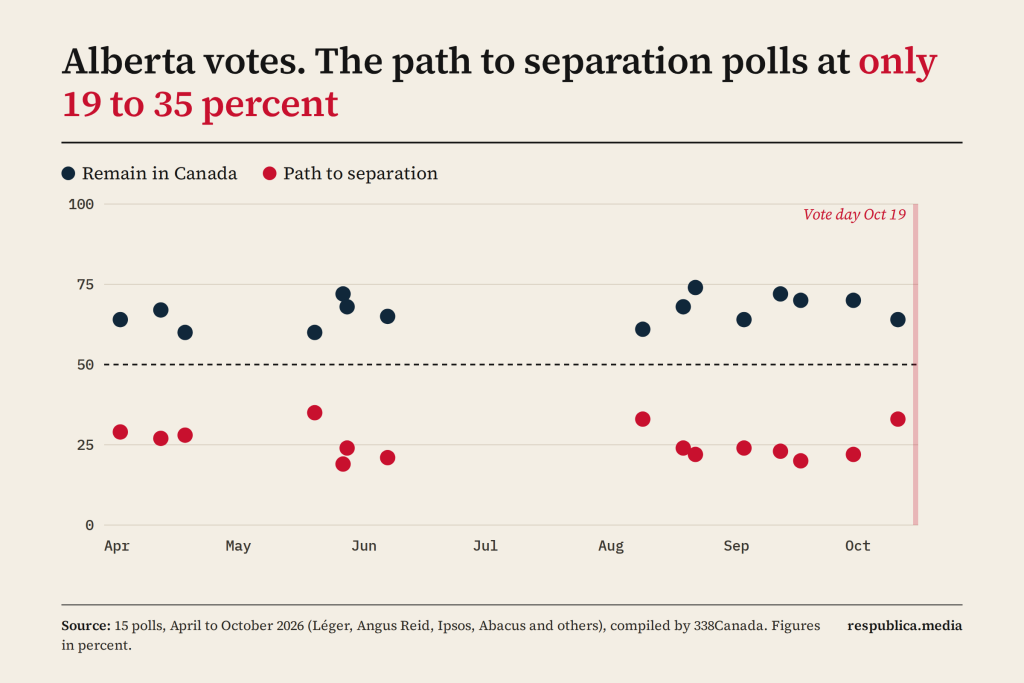
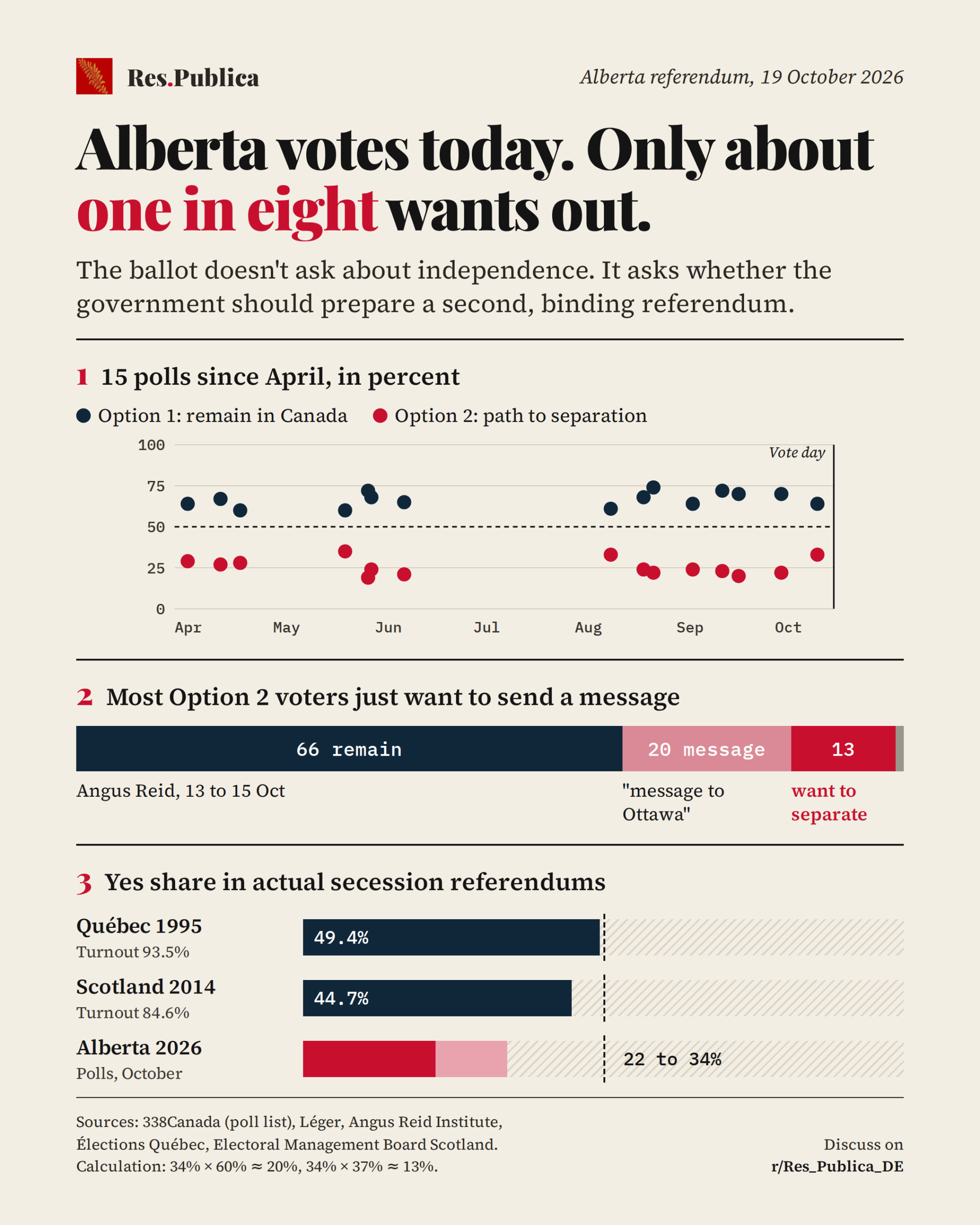
At least 15 polls on Question 10 have been published since April, collected by 338Canada. Option 2, the path to separation, has ranged between 19 and 35 percent in all of them. The picture is stable: Ipsos, Léger and Research Co. tend to land in the low 20s, the Angus Reid Institute regularly in the low 30s. Much of that gap comes down to how pollsters handle undecided voters. Léger’s latest poll (2 to 4 October) has 70 percent for remaining, 22 percent for Option 2 and 7 percent undecided. Angus Reid (13 to 15 October) doesn’t report undecideds and has it at 66 to 34.
The Writ’s polling average stood at 68 to 26 on 18 October.
Who actually wants out
The more interesting number is the why. Angus Reid asked Option 2 voters what’s driving their vote. 60 percent said it’s about sending a message to Ottawa. Only 37 percent said they actually want Alberta to separate.
Scale that up to all respondents: 34 percent for Option 2 times 37 percent who want separation comes to roughly 13 percent. So about one in eight respondents really wants out. The other 20-odd percent are using the vote as a protest. That’s our own calculation based on a single poll, so it comes with a margin of a few points either way. The order of magnitude holds.
Angus Reid asked the same thing in August, when 41 percent of Option 2 voters said it was about sending a message. If anything, the protest share has grown.
How it compares to Québec and Scotland
Québec voted on sovereignty in 1995 and fell short by 54,288 votes, with 49.42 percent Yes on 93.52 percent turnout. Scotland reached 44.7 percent Yes in 2014, on 84.6 percent turnout. Both votes were about secession itself, not about a process leading there.
Alberta is nowhere near that. Even counting every protest voter, Option 2 sits 10 to 27 points below what Scotland and Québec achieved in the October polls (22 to 34 percent).
Why the result still matters
In its 1998 reference on Québec secession, the Supreme Court of Canada ruled that a province cannot secede unilaterally. But a clear majority on a clear question would oblige the rest of Canada to negotiate. What counts as “clear” was deliberately left to politicians.
A strong Option 2 result would therefore be a political signal Ottawa would struggle to ignore, even if it triggers nothing legally. Turnout looks high: according to AP, more than a million people had voted in advance or by mail by Friday. That makes any result harder to wave away, in either direction.
Prime Minister Mark Carney campaigned for Canada in Calgary in the final days, with an appearance in Edmonton planned. Conservative leader Pierre Poilievre has also urged Albertans to reject the path to separation.
When the result comes in
Polls are open from 9 am to 8 pm local time, which is 4 am Tuesday in Central Europe. Question 10 is counted first at every polling station, by hand. The unofficial count has to be finished within 48 hours, and Elections Alberta will announce the official result on 29 October. We’ll add the result here once it’s in.
Sources
- Elections Alberta, 2026 referendum, wording of Question 10 and counting: https://www.elections.ab.ca/elections/referendum/
- Elections Alberta, voting day and results: https://www.elections.ab.ca/current-election-information/
- Calgary Chamber, the ten questions explained (O.C. 160/2026, quashed petition): https://calgarychamber.com/whats-new/ten-referendum-questions-explained-policy/
- Angus Reid Institute, poll 13 to 15 October 2026: https://angusreid.org/alberta-referendum-remain-continues-to-lead-by-a-wide-margin-but-few-believe-separation-issue-will-end-on-oct-19/
- Angus Reid Institute, poll 10 to 13 August 2026: https://angusreid.org/alberta-referendum-polling-sending-a-message-danielle-smith-seperation/
- Léger, poll 2 to 4 October 2026: https://leger360.com/alberta-referendum-october-2026/
- 338Canada, all polls since April: https://338canada.com/alberta/polls-indy.htm
- The Writ, polling average: https://www.thewrit.ca/p/alberta-referendum-poll-tracker
- AP via Spokesman-Review, advance votes, Smith, Carney, Poilievre: https://www.spokesman.com/stories/2026/oct/16/alberta-early-voter-surge-suggests-edge-for-canadi/
- Élections Québec, 1995 result: https://www.electionsquebec.qc.ca/en/results-and-statistics/1995-referendum-on-quebecs-accession-to-sovereignty/
- Electoral Management Board for Scotland, 2014 result: https://emb.scot/scottish-independence-referendum-2014-3/scottish-independence-referendum-18-september-2014
- Supreme Court of Canada, Reference re Secession of Quebec (1998): https://decisions.scc-csc.ca/scc-csc/news/en/642/1/document.do