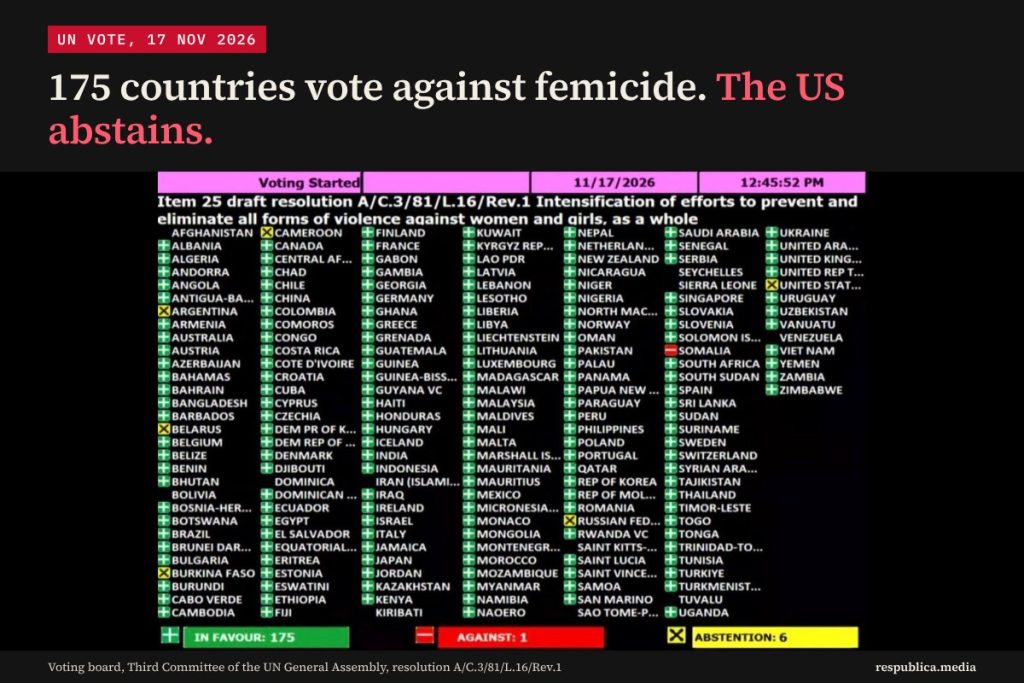
175 countries in the UN General Assembly’s Third Committee voted for a resolution on violence against women and girls, focused on femicide. The United States abstained, alongside Russia, Belarus, Argentina, Cameroon and Burkina Faso. Somalia was the only country to vote against. What lies behind the abstentions, and why Washington’s reasoning does not hold up.
Res.Publica, 18 November 2026.
On 17 November, the Third Committee of the UN General Assembly, which handles social, humanitarian and human rights issues, adopted resolution A/C.3/81/L.16/Rev.1, “Intensification of efforts to prevent and eliminate all forms of violence against women and girls”. The resolution is renewed regularly. This year’s focus is on gender-related killings of women and girls, in other words femicide. The text was introduced by the Netherlands and France.
The result according to the voting board: 175 in favour, 1 against, 6 abstentions.
- Against: Somalia
- Abstained: United States, Russia, Belarus, Argentina, Cameroon, Burkina Faso
- Did not vote: Afghanistan, Bolivia, Dominica, Iran, Kiribati, Saint Kitts and Nevis, São Tomé and Príncipe, Seychelles, Sierra Leone, Tuvalu, Venezuela
The eleven missing votes are left out of most posts about the vote. But no position can be read into them: a missing vote can mean absence, arrears in UN contributions or, in Afghanistan’s case, disputed representation.
What the countries give as reasons
United States: Washington says it supports the goal of combating violence against women and girls but could not back the text as a whole. The US delegation objects to references to “gender”, to sexual and reproductive health and to sexuality education. It also argues that some language could override national laws and priorities. The US Mission’s official explanation of vote exists but could not be accessed directly by us; we rely on how several media reports rendered it.
Belarus: After the vote, the Belarusian representative said the text reflects “the interests of only certain organizations”. Minsk rejects language on “gender ideology”, girls’ sexual autonomy, comprehensive sexuality education, abortion and revisiting traditional approaches to the family. It also objects to calling on all states to pass laws against gender-related killings without regard for national legal systems. Belarus says it will interpret contested passages in line with its own law.
Somalia, Russia, Argentina, Cameroon, Burkina Faso: We could not find a stated reason by the time of publication. According to Kaab TV, Somalia has not commented at all. Argentina under Javier Milei has voted with the US on gender issues strikingly often since 2024.
Another point of dispute in the committee was a sovereignty clause: a new paragraph would have stated that the resolution is to be implemented with respect for national laws and religious and cultural values. Human rights groups saw it as a blank cheque for any state to read the resolution as it pleases.
Why the US reasoning does not hold up
First: General Assembly resolutions are not binding. The argument that the text could override national laws goes nowhere. No country has to change a single law because of this resolution.
Second: Washington says it supports the goal. Yet it abstains on a text whose core is protecting women from being killed, over words like “gender” and sexuality education. In this abstention, the wording weighs more than the substance.
Third, this is not a slip but a pattern. On 10 November, the US tried to make reproductive health subject to national laws in the resolutions on female genital mutilation and obstetric fistula. The committee decided not to even vote on the amendments. In March, the US was the only country to vote against the conclusions of the UN Commission on the Status of Women, 37 to 1. It was the first time in 70 years that the commission could not adopt its conclusions by consensus.
If you end up in the same column as Russia and Belarus on violence against women, it is worth asking whether your reasoning really carries that.
What happens next
The vote on 17 November took place in committee. The General Assembly will take the final vote in plenary in December. Votes sometimes still change there: in 2024, Argentina voted against a resolution on digital violence against women in committee and then in favour in plenary.
Sources
- Horn Diplomat, vote result: https://www.horndiplomat.com/somalia-alone-votes-against-un-draft-on-violence-against-women/
- US Mission to the United Nations, explanation of vote: https://usun.usmission.gov/explanation-of-vote-for-unga-81-3c-resolution-intensification-of-efforts-to-prevent-and-eliminate-all-forms-of-violence-against-women-and-girls/
- reform.news, Belarus statement (Russian): https://reform.news/belarus-ne-podderzhala-rezoljuciju-oon-protiv-nasilija-v-otnoshenii-zhenshhin/
- Kaab TV, Somalia gave no explanation: https://en.kaabtv.com/somalias-un-vote-on-womens-rights-raises-questions/
- Política Argentina, Argentina and US reasons (Spanish): https://www.politicargentina.com/notas/202611/77176-175-paises-votaron-contra-la-violencia-hacia-las-mujeres-argentina-se-abstuvo-junto-a-camerun-somalia-y-burkina-faso.html
- Diario de Rivera, Argentina’s votes in 2024 (Spanish): https://www.diarioderivera.com.ar/2026/11/17/la-onu-voto-una-iniciativa-para-combatir-la-violencia-contra-mujeres-y-ninas-argentina-se-abstuvo/
- UN Press, Third Committee on 10 Nov 2026: https://press.un.org/en/2026/gashc4457.doc.htm
- CFR, assessment of the 70th Commission on the Status of Women: https://www.cfr.org/articles/justice-for-women-and-girls-an-assessment-of-the-70th-un-commission-on-the-status-of-women
- ISHR, dispute over the sovereignty clause: https://ishr.ch/latest-updates/unga81-civil-society-calls-on-states-to-uphold-multilateralism-and-reject-sovereignty-opt-out-on-violence-against-women-resolution/