When white smoke rose above the Sistine Chapel on May 8, 2025, the surprise was immediate. The Catholic Church, an institution that had spent two millennia avoiding American leadership out of fear of concentrating too much worldly power in one nation, had just elected a 69-year-old mathematician from Chicago as the 267th Bishop of Rome. Robert Francis Prevost took the name Leo XIV. The world called it unexpected. But for anyone who had watched Francis’ personnel decisions over the previous decade, it was anything but.
One year later, the story of this papacy is not one of surprise. It is one of careful construction, tested by events that no amount of planning could have anticipated: a new war in the Middle East, an American president who publicly attacks popes on social media, and a global church fracturing along cultural fault lines that run deeper than any one leader can bridge. The impressive architecture of Leo’s appointment is beyond doubt. Whether substance matches the symbolism is a different matter.
The Successor Who Was Built, Not Found
The conventional narrative says conclaves are unpredictable. The 2025 conclave was not. A book published in early 2026 by Vatican correspondents Gerard O’Connell and Elisabetta Piqué, The Election of Pope Leo XIV, reveals a pattern of deliberate preparation that stretches back years.
Francis appointed Prevost Bishop of Chiclayo, Peru, in 2015, giving him pastoral credibility in Latin America. In 2023, he brought Prevost to Rome as Prefect of the Dicastery for Bishops, the office that selects every bishop in the Catholic world, and elevated him to Archbishop and Cardinal in the same year. By the time Francis died on April 21, 2025, Prevost sat at one of the most powerful intersections in Vatican governance. He knew the candidates. The candidates knew him.
The conclave bore this out. Prevost was elected on the fourth ballot, just two days in. Latin American cardinals, according to Piqué’s reporting, described him as “although a gringo, one of us.” His two decades in Peru made him legible to the Global South. His American passport made him strategically interesting to everyone else.
— Elisabetta Piqué, The Election of Pope Leo XIV
None of this is conspiracy. It is institutional strategy, and it is worth naming clearly. The Catholic Church chose an American pope at the precise moment when the United States was escalating military operations in the Middle East, deporting immigrants at unprecedented scale, and leading the global race in artificial intelligence development. A pope who could speak to American power from the inside, with the moral authority to say “I am one of you, and this is wrong,” is not an accident of the Holy Spirit. It is a decision.
The Trump Collision
The strategic logic behind Leo’s election got its proof of concept sooner than anyone expected. Donald Trump provided it.
The confrontation began in early 2026, when Leo called Trump’s threat to destroy Iran’s “whole civilization” “truly unacceptable.” He followed with an April 10 social media post: “God does not bless any conflict. Anyone who is a disciple of Christ, the Prince of Peace, is never on the side of those who once wielded the sword and today drop bombs.” On Palm Sunday, he declared that God “does not listen to the prayers of those who wage war.”
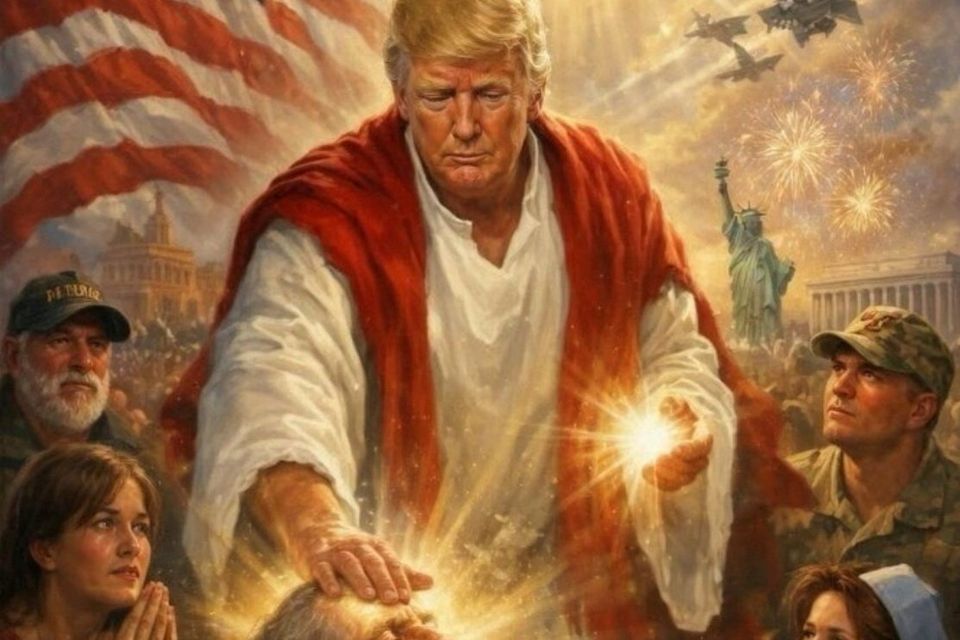
Trump’s response was characteristically unrestrained. On Truth Social, he called Leo “WEAK on Crime, and terrible for Foreign Policy” and demanded the pope “get his act together” and “stop catering to the Radical Left.” He claimed, without basis, that Leo owed his papacy to him: “He wasn’t on any list to be Pope, and was only put there by the Church because he was an American, and they thought that would be the best way to deal with President Donald J. Trump.” He also posted, and later deleted, an AI-generated image depicting himself in the likeness of Jesus Christ.
Vice President JD Vance, a Catholic convert, told the pope to “stay out of politics” and focus on “matters of morality,” apparently unaware that the pope’s entire point was that war is a matter of morality.
Leo’s response was measured but firm. Aboard the papal plane to Africa, he told reporters: “I have no fear of the Trump administration, or speaking out loudly.” Later, from Cameroon, he softened: his speeches had been written weeks before Trump’s attack, he said, and debating the president “is not in my interest at all.”
The strategic dimension of his papacy becomes visible here. An Italian or Nigerian pope criticizing American foreign policy can be dismissed as anti-American. An American pope born and raised in Chicago doing the same thing carries different weight. Trump seemed to sense this, which likely explains the disproportionate ferocity of his attacks. The usual playbook, dismissing foreign critics as irrelevant outsiders, falls apart when the critic carries an American passport and leads 1.4 billion people.
→ Feb 28, 2026: U.S.-Israeli strikes on Iran begin (Operation Epic Fury). Leo expresses “deep concern.”
→ March 2026: Leo’s Palm Sunday homily: God “does not listen to the prayers of those who wage war.”
→ April 7: U.S.-Iran two-week ceasefire. The exchange continues regardless.
→ April 10: Leo’s social media post: “God does not bless any conflict.”
→ April 12: Trump calls Leo “WEAK on Crime, terrible for Foreign Policy.” Posts AI Jesus image.
→ April 13: Leo departs for Africa. Tells reporters he has “no fear” of speaking out.
→ April 16: In Cameroon, Leo condemns “a handful of tyrants” spending billions on war.
→ April 19: Leo says debating Trump “is not in my interest.” Vance responds: “grateful.”
Rhetoric vs. Record: A Systematic Audit
Leo’s first year has produced powerful moments and resonant language. But institutions are not changed by language alone. The record, examined issue by issue, tells a more complicated story than the headlines suggest.
Peace and War
Leo has called for ceasefires in Ukraine and Gaza, condemned the Iran war, and denounced “a handful of tyrants” in a speech in Cameroon. In his first apostolic exhortation, he placed the poor, migrants, and the vulnerable at the center of Christian life and warned against what he called a “delusion of omnipotence” in global politics.
The moral clarity is real. But what has the Vatican achieved diplomatically? The U.S.-Iran ceasefire was brokered without visible Vatican involvement. Leo’s directness is admirable. So was Francis’ on Ukraine, for a decade, with limited measurable effect. Papal words have yet to prove they can move geopolitical outcomes.
Institutional Reform
In January 2026, Leo convened a consistory of cardinals and proposed regular annual meetings of the College of Cardinals, a shift from Francis’ more personal governing style. He declared the Second Vatican Council the “guiding star” of the Church and began a catechesis series on Vatican II documents. He dissolved a questionable fundraising commission created in Francis’ final weeks and canceled the World Day of Children initiative that had lacked clear purpose.
Leo’s background as Prior General of the Augustinian order shows here. He spent over a decade governing a global religious network and learned to manage diversity through institutional processes rather than personal charisma. The annual consistory model is a real governance innovation for the modern papacy.
Sexual Abuse
In Spain, Leo called abuse a “scourge” and demanded “listening, truth, justice, reparation and an ever more determined commitment to prevention.” He met privately with victims. He described the scandal as “still an open wound” for the Church.
An estimated 200,000 minors have been abused by clergy in Spain alone since 1940. Leo’s language is compassionate, but one year in, no new institutional mechanisms beyond those created under Francis are publicly known. The Church’s credibility deficit on abuse will not be closed by pastoral language, however sincere. It requires structural accountability that has not yet materialized.
LGBTQ+ Rights and Women in the Church
Leo has explicitly said it is “very unlikely” the Church will change its teaching on sexuality and marriage. He reframed the question by arguing that “justice, equality, freedom of men and women, freedom of religion” should all “take priority” over sexual morality as issues of Church concern. Prior to becoming pope, he described “homosexual lifestyle” as “at odds with the gospel” and opposed transgender education in Peruvian schools. On women’s ordination to the diaconate and priesthood, he has been notably cautious, neither advancing nor reversing Francis’ positions.
Leo has reframed avoidance as wisdom. By arguing that sexuality is a less important moral question than justice or equality, he sidesteps the issue rather than engaging it. For LGBTQ+ Catholics who hoped Francis’ tentative openings would expand, Leo offers continuity at best, retreat at worst. The women’s ordination question remains untouched. This is not neutrality. It is a choice not to act.
The Slavery Apology
On May 25, 2026, Leo published “Magnifica Humanitas,” his first encyclical, focused on human dignity in the age of artificial intelligence. Embedded within it was a historic first: an explicit papal apology for the Holy See’s own role in legitimizing slavery. No previous pope had acknowledged that past popes personally authorized European sovereigns to enslave non-Christians through directives like the 1452 bull Dum Diversas, which gave the Portuguese king the right to “invade, conquer, fight and subjugate” and “reduce their persons to perpetual slavery.”
Leo wrote: “It is impossible not to feel deep sorrow when contemplating the immense suffering and humiliation endured by so many in stark contrast to their immeasurable dignity as persons infinitely loved by the Lord. For this, in the name of the Church, I sincerely ask for pardon.”
The apology is genuinely unprecedented. But the Vatican formally repudiated the Doctrine of Discovery in 2023 without ever formally rescinding the papal bulls that created it. Dum Diversas and Romanus Pontifex remain part of the canonical record. Leo apologized for what past popes did under those documents without revoking the documents themselves. “Repudiate” is not “rescind.” That is a canonical distinction the Vatican maintains deliberately. An apology that does not undo the legal framework it apologizes for is symbolism, not resolution.
Engagement with Authoritarian Regimes
During his Africa trip, Leo met with Cameroon’s Paul Biya, 93 years old, in power since 1982, whose eighth term was secured through what human rights groups called massive fraud. A prominent Jesuit priest in Cameroon publicly urged the pope not to come, warning the visit could be read as an endorsement. In Equatorial Guinea, Leo visited Teodoro Obiang, Africa’s longest-serving president (since 1979), whose family has enriched itself while over 70% of the population lives in poverty.
Leo criticized corruption in speeches at both presidential palaces. But the very act of visiting, shaking hands, and sharing stages with leaders accused of systematic repression sends a message that no amount of carefully worded criticism can fully counteract.
Popes visit countries, not governments, and the Catholic faithful in Cameroon and Equatorial Guinea deserve their shepherd. But the Church also has a long history of lending legitimacy to strongmen through proximity, and Leo’s predecessors were criticized for the same pattern. A pope who calls out “tyrants” in the abstract while dining with specific ones creates a credibility gap.
* * *
The Mathematician’s Papacy
There is a pattern in all of this. Leo is methodical, process-oriented, and formal, a mathematician who approaches Church governance like a system to be optimized rather than a stage to perform on. Where Francis was a disruptor who broke protocol and made headlines through gestures, Leo builds structures. Annual consistories. Vatican II catechesis series. An encyclical that links 15th-century slavery to 21st-century AI supply chains.
This approach has real strengths. The institutional reforms are more durable than personal charisma. The Vatican II emphasis gives the progressive wing of the Church a doctrinal anchor that will outlast any one papacy. The refusal to engage in a Twitter war with Trump, while still stating moral positions clearly, shows a discipline that Francis’ more impulsive style sometimes lacked.
But it also has a cost. On the issues where structural change is most urgently needed, abuse accountability, LGBTQ+ inclusion, women’s roles, Leo’s process orientation starts to resemble delay dressed up as prudence. “I try not to fuel polarization” is a defensible position in the abstract. In practice, it means that the people asking for change are told to wait, again, while the people resisting change are told nothing needs to happen, yet.
— Pope Leo XIV, April 2026
This reframing is intellectually honest but strategically convenient. Justice, equality, and freedom are indeed important. But a pope who speaks of justice while declining to address the Church’s own unjust treatment of gay and transgender Catholics is not prioritizing, he is selecting which injustices are comfortable enough to confront.
The Unfinished Picture
Leo XIV’s first year defies a clean verdict. It is the opening act of a pontificate that has revealed its method, careful, strategic, institutionally minded, without yet revealing its full ambition.
The positives are real. The slavery apology, however incomplete, is a genuine historical first. The institutional reform of Vatican governance through regular consistories represents a durable structural change. The willingness to challenge American military power from within, as an American, represents a new form of papal moral authority. The 1.2 million faithful in Madrid and the 30,000 in the rain in Malabo show a leader who connects with people, not just systems.
But the gaps are equally real. The Church continues to lose ground in its historical heartlands: only 56% of Spaniards now identify as Catholic, down from 73.5% in 2011, and only 18.5% of those are practicing. The SSPX has announced plans to consecrate bishops without papal authorization, threatening formal schism. And on the questions that most divide the Church’s future membership, gender, sexuality, who gets to lead, Leo has chosen caution over courage.
Francis built his successor to be a bridge between North and South, between institutional competence and pastoral warmth, between American credibility and global vision. One year in, the bridge stands. What Leo XIV chooses to carry across it will define this papacy.
The world has plenty of leaders who speak well about justice. It has very few who deliver it structurally, permanently, against institutional resistance. Leo’s second year will show which category he belongs to.
Sources
- CNN: Robert Prevost elected as first American pope, May 2025
- Vatican News: Leo XIV is the new Pope, May 2025
- NPR: Who is the new Pope Leo XIV?, May 2025
- The Jesuits: Habemus Papam: Cardinal Robert Prevost, May 2025
- CNN: How Pope Leo was elected: New details, March 2026
- National Catholic Reporter: Pope Leo signals reforms with Holy Year over, January 2026
- America Magazine: Pope Leo’s papacy began today, January 2026
- National Catholic Reporter: Leo pledges to pursue reforms of Francis, May 2025
- The Conversation: In his first year as pope, Leo has emphasised peace, unity and social responsibility, April 2026
- CNN: Six key things we learned about Pope Leo, May 2026
- Crux: A year in, what’s on Pope Leo XIV’s to-do list?, May 2026
- Time: Pope Leo responds to attack by Trump, April 2026
- CBS News: How the dispute between Trump and Pope Leo escalated, April 2026
- NPR: Popes have spoken out before, but with Trump and Pope Leo it’s different, April 2026
- NPR: Pope Leo takes aim at ‘handful of tyrants’, April 2026
- CNN: Pope Leo addresses spat with Trump, April 2026
- Time: The biggest challenges Pope Leo XIV faces, May 2025
- The Advocate: Pope Leo XIV signals no new ground for LGBTQ+ Catholics, April 2026
- Euronews: Pope Leo XIV: ‘No change in Church doctrine on gays and trans people’, February 2026
- The Week: Where the new Pope Leo XIV stands on social issues, May 2025
- USCCB: Pope Leo calls for ‘openness’ to Church reform, May 2026
- CBS News: Pope Leo denounces “scourge” of sexual abuse, June 2026
- NPR: A country-by-country glance at Pope Leo’s trip to Africa, April 2026
- National Catholic Reporter: In Africa, Pope Leo’s quiet papacy came into full view, May 2026
- PBS: Pope wraps up Africa visit for the history books, April 2026
- PBS: Highlights of Pope Leo’s trip to Africa, April 2026
- PBS: Pope Leo makes historic apology for Vatican’s role in legitimizing slavery, May 2026
- America Magazine: Pope Leo XIV makes historic apology for Catholic Church’s role in legitimizing slavery, May 2026
- National Catholic Reporter: Pope Leo makes historic apology for Holy See’s own role in legitimizing slavery, May 2026
- PBS: Photos: Pope Leo honors Gaudi’s Sagrada Familia masterpiece, June 2026
- America Magazine: Pope Leo’s trip to Spain: Background, June 2026
- NBC News: Pope Leo to hold iconic Mass at Sagrada Família, June 2026