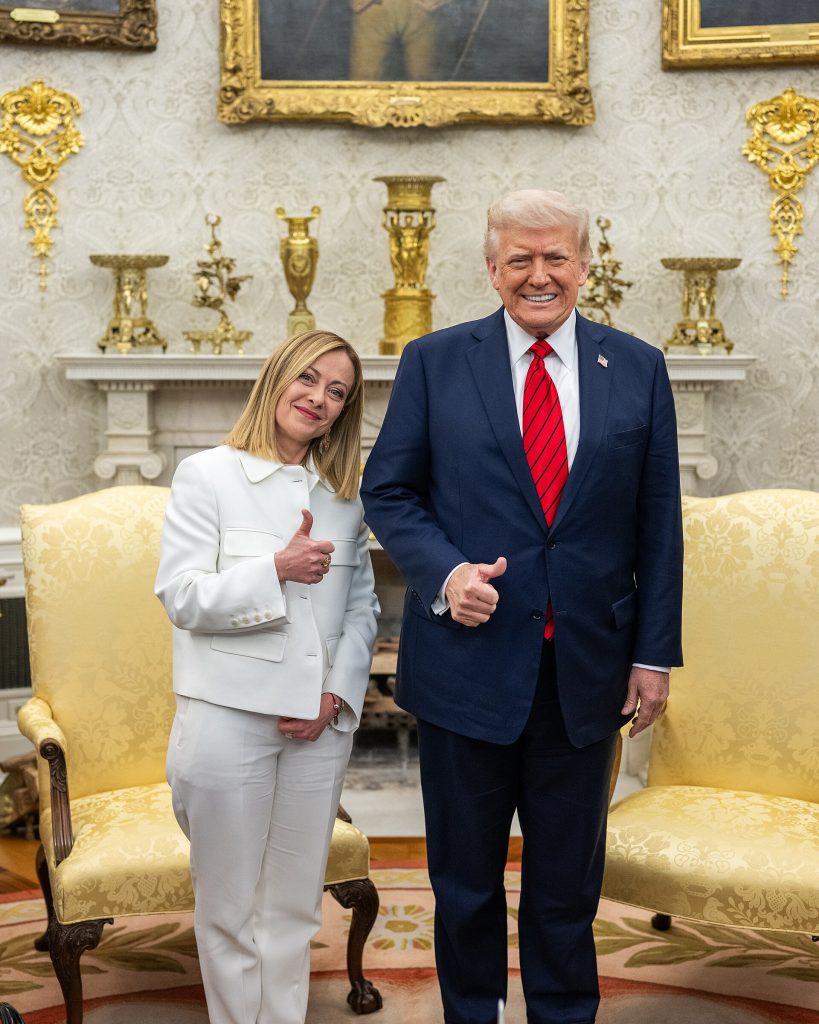
Seventeen months ago, Giorgia Meloni was the only European leader sitting in the front row at Donald Trump’s inauguration. She had flown to Mar-a-Lago before that. She had called the United States and Italy “sister nations.” She had positioned herself, carefully and deliberately, as Europe’s bridge to Washington.
That bridge collapsed this week over a selfie that never happened.
The Interview
On Thursday evening, La7 correspondent Daniele Compatangelo called the White House for a routine interview. He asked about Ukraine. Trump ignored the question and pivoted to Meloni.
What followed was remarkable. According to La7’s Italian dub of the call, Trump claimed Meloni had “begged” him for a photograph at the G7 summit in Évian. He said he agreed because he “felt sorry for her.” He suggested she was “probably happy” he spoke to her at all. The original English audio has not been released. La7 explained that White House staff directives prohibit releasing original call recordings, only transcriptions are permitted.
Compatangelo later told Italian media that Trump himself steered the conversation toward Meloni, unprompted. The journalist said he got the impression the president “wanted to get something off his chest.”
He did. And the fallout was immediate.
Italy Responds
Meloni posted a video on X within hours. “Donald Trump’s statements are completely fabricated. I am frankly stunned.” Her voice was controlled but the message was not. She said she did not understand why the president of the United States “behaves this way toward his own allies.” Then the line that will define this episode: “I and Italy never beg.”
She was not finished. “I can only say it is regrettable he does not show the same determination toward the enemies of the West, toward leaders with whom he is far more accommodating.”
That is not diplomatic language. That is a sitting NATO ally publicly accusing the American president of being soft on dictators while bullying democracies. From someone who attended his inauguration five months earlier.
Foreign Minister Antonio Tajani cancelled his planned visit to Washington and called Trump’s remarks “an insult to all of Italy.” A planned Italian-American economic forum in Miami was scrapped. Italian officials pulled out of US Independence Day celebrations scheduled in Rome. Giovanbattista Fazzolari, undersecretary to the prime minister’s office, issued a statement that deserves to be quoted in full context: “It is unclear whether out of intent or ineptitude he is wrecking the historic relations between the United States and Europe.”
Trump responded the way Trump responds. He doubled down.
The Doubling Down
Saturday morning, from Camp David, Trump took to Truth Social. He misspelled her name as “Gigiorgia” (later corrected) and wrote that she had asked “over and over” for a photo. He claimed she was “doing poorly in Italy with her level of popularity” and that she now “wants to be friends again in order to get her ‘numbers up.’ No thanks!!!”
The irony of that attack is visible in the polling data. Meloni’s personal approval sits around 42-45 percent. Her Brothers of Italy party leads Italian polls at 28 percent. Trump’s own approval rating, according to a Reuters/Ipsos poll from the same week, stands at 36 percent, near the lowest of his political career.
Meloni’s reply came on Instagram, written in English so there would be no translation issues this time: “President Trump, these constant, unprovoked attacks are senseless. As for my popularity, being your friend certainly has not helped it, nor does it depend on my relationship with you. My popularity depends on my ability to defend Italy’s national interest, and that is exactly what I have always done.” Then the knife: “In any case, my popularity is none of your concern. I suggest you focus on yours.”
The Real Conflict
The photo story is theater. The actual dispute is about a military base on the island of Sicily.
In late March, Italy’s defense ministry confirmed that US bombers had been denied landing rights at Sigonella, a NATO air and naval base that has served as a critical American logistics hub in the Mediterranean for decades. The reason: Italy’s constitution requires parliamentary approval for the use of its territory in offensive military operations. The Iran war, which the US and Israel launched on February 28, did not have that approval. And Meloni’s government was not going to seek it.
This was not a bureaucratic technicality. Italian public opinion is overwhelmingly opposed to the war. Meloni had already broken with the Trump administration publicly, saying “we do not agree” with the US approach and calling the military action illegal. Allowing American bombers to use Sigonella would have been political suicide domestically and a violation of Italian constitutional law.
Trump’s Truth Social post made the connection explicit. “She wouldn’t even let us use Italy’s landing strips or runways, a great logistical inconvenience,” he wrote, adding that the US “contributes hundreds of Billions of Dollars a year to protect Italy.”
Meloni’s response on that point was equally explicit: “Their use is governed by agreements that we have always respected and that cannot be violated. As long as I am prime minister, Italy remains a sovereign nation.”
The Timeline of Collapse
The relationship did not break overnight. It eroded in stages, each one tied to the Iran conflict.
In January 2025, Meloni attended Trump’s inauguration. Headlines called her Europe’s “Trump whisperer.” In February, Trump praised her as a “fantastic leader” who had “really taken Europe by storm.” He called her a “beautiful young woman.” The patronizing tone was already there. She tolerated it.
February 28, 2026: the US and Israel strike Iran. Italy refuses Sigonella access within weeks.
April 2026: Trump attacks Pope Leo XIV on Truth Social after the pontiff condemns the war. “Pope Leo is WEAK on Crime, and terrible for Foreign Policy,” he wrote. Meloni, governing a Catholic country, calls the attacks “unacceptable.” Trump tells the Corriere della Sera: “I thought she had courage, but I was wrong.”
June 15-17: the G7 summit in Évian. Photographs show Trump and Meloni sitting together on a couch, apparently having a constructive conversation. Italian diplomatic sources speak of a “clarifying discussion.” Meloni tells the press the atmosphere was “very positive” with “no friction.”
June 19: the La7 interview airs. Whatever happened on that couch, it did not stick.
Not Just Meloni
The collapse of the Trump-Meloni relationship does not exist in isolation. It is the most dramatic example of a pattern that now covers virtually the entire European continent.
Germany’s Friedrich Merz described the US as having been “humiliated” in its negotiations with Iran. Trump responded by threatening to reduce the American military presence in Germany. In France, Marine Le Pen, who once aligned closely with Trump’s nationalist agenda, called his foreign policy “erratic.” Jordan Bardella, president of Le Pen’s National Rally, warned against what he called a return to “imperial ambitions.” Even Nigel Farage in Britain called Trump’s pressure on Greenland a “very hostile act.”
When Nigel Farage is calling you hostile, the coalition has collapsed.
Nathalie Tocci, director of the Italian Institute of International Affairs, put it bluntly to the media: “It’s now clear to all European leaders, and finally to Meloni too, that having a good political relationship with Trump is impossible.”
Former Italian Prime Minister Matteo Renzi, a center-left opponent of Meloni, called Trump’s statements “horrifying, as always” and then added a pointed observation: that Meloni had “finally” noticed. He called on her to abandon her ties to Trump entirely and declared that “the global right has failed.”
What Comes Next
The NATO summit in Ankara, Turkey is scheduled for next month. Trump will attend. Meloni will attend. The question of burden-sharing, base access, and the Iran war will be on every agenda, spoken or not.
Italy hosts seven US military installations. Sigonella alone handles NATO’s Alliance Ground Surveillance program, a drone-based intelligence operation with no alternative location. The bilateral defense relationship is too deep to sever over a photo dispute, and both sides know it.
But something has shifted that cannot be unshifted. Meloni is no longer managing Trump. She is confronting him. Publicly, in English, on platforms where every European voter can read it. The “Trump whisperer” framing is dead. What replaced it is a leader who told the most powerful man in the world that his popularity is none of her concern and that he should focus on his own.
Seventeen months from inauguration guest to “No thanks.” That is the speed at which this American president burns through allies. Not adversaries. Allies.
Meloni was right about one thing. He does show far more resolve toward friends than enemies.