From July 2027, Germany plans to tax sugary drinks. In the Bundestag’s lobby register, 51 organisations have reported lobbying on it. The sugar and drinks industry is almost united against it, doctors and consumer groups are in favour, and retailers want to shape it. What they write and who is behind them.
A joint investigation by Res.Publica and politblick.de. 7 November 2026. Lobby register data as of 6 November 2026.
The federal cabinet approved the tax on 14 October. Drinks with at least 5 grams of sugar per 100 millilitres are to be taxed at 26 cents per litre, from 8 grams at 32 cents. Pure juices, unsweetened spritzers, alcoholic drinks and drinks sweetened with sweeteners instead of sugar are exempt. Small producers with less than one million litres a year are to be exempt if the European Commission agrees. The government expects around 690 million euros in the first year and 925 million euros in 2028. The money is meant to help keep health insurance contributions stable.
The tax had already been announced in the health insurance savings law the Bundestag passed on 10 July. Now the Bundestag has to approve the tax law itself. The CSU wants to delay the start to January 2028 so producers can change their recipes.
51 organisations, three camps
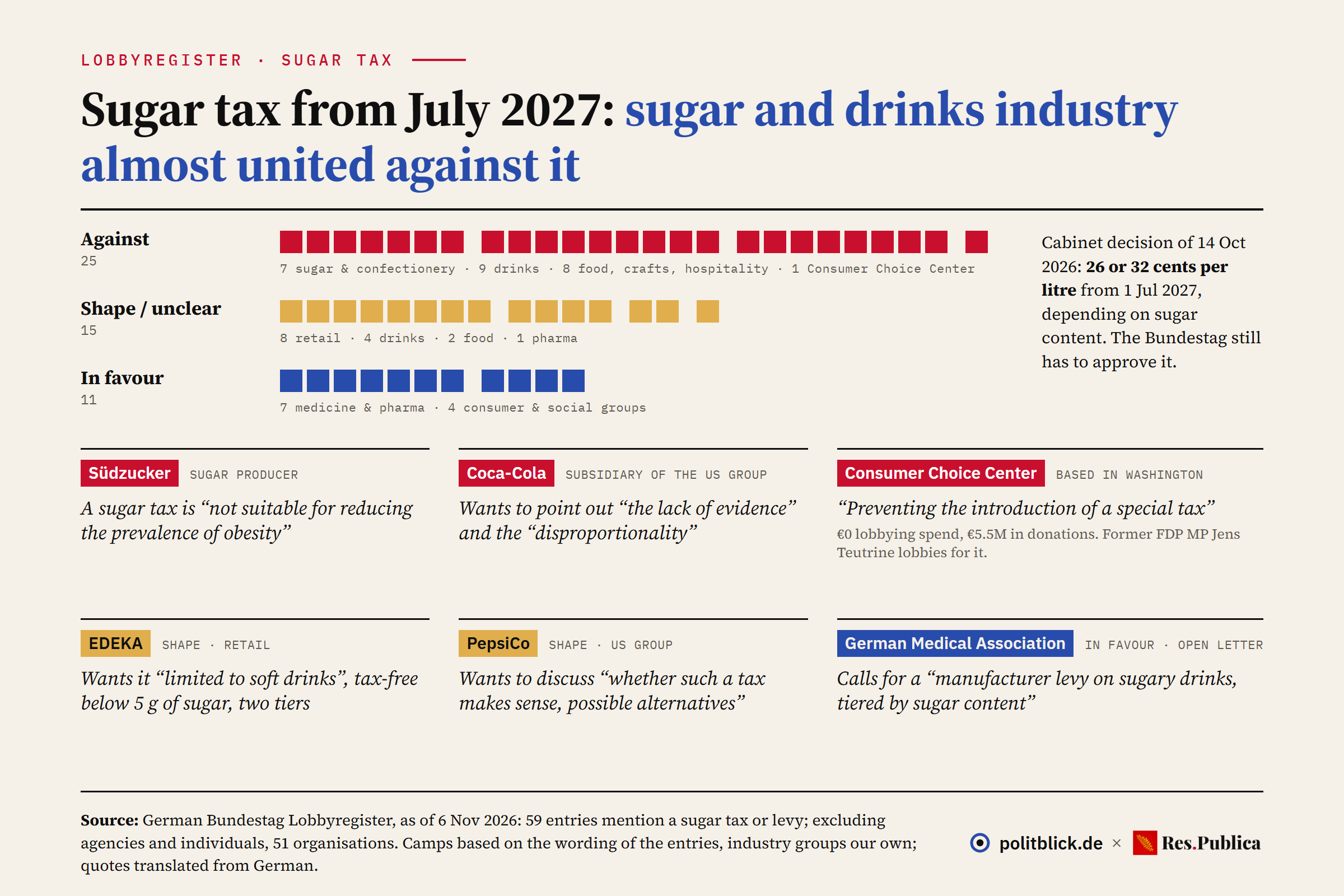
politblick.de searched every entry in the lobby register that mentions a sugar tax or levy. There are 59. Agencies and individuals working on behalf of others were left out so nobody is counted twice. That leaves 51 organisations. Sorted by the wording of their entries:
- 25 against
- 15 want to shape or limit it, or take no clear position
- 11 in favour
Against: sugar, soft drinks, brewers, bakers
The opposing side covers almost the whole chain from beet field to bar. Sugar producers Südzucker, Nordzucker and Pfeifer & Langen and their associations. The drinks industry with the soft drinks association wafg, mineral water producers, the fruit juice industry, beverage wholesalers and Coca-Cola. Plus brewers, bakers, Haribo, the confectionery industry, the food industry associations, the crafts sector and the hospitality sector.
The arguments are similar. The wafg writes that “excise taxes on individual categories or ingredients are not a sensible instrument”; what matters is lifestyle as a whole. Südzucker calls a sugar tax “not suitable” for reducing obesity. Südzucker reports just over one million euros a year in lobby spending, the wafg around 555,000 euros.
Coca-Cola appears twice: Coca-Cola GmbH, a subsidiary of The Coca-Cola Company of Atlanta, and Coca-Cola Europacific Partners, the bottler. It is an independent company based in the UK and not part of the Coca-Cola Company. Coca-Cola GmbH writes that its aim is “to point out the lack of an evidence base and the disproportionality of possible new rules”. It considers measures that target “specific ingredients or food groups” unsuitable.
The bluntest position comes from the Consumer Choice Center, an association based in Washington. Its stated goal: “preventing the introduction of a special tax on sugary foods or drinks”. Instead of levies it calls for “transparent consumer information, nutrition education and real freedom of choice”. Former FDP MP Jens Teutrine lobbies for the association. The Consumer Choice Center reports 0 euros in lobby spending but 5.47 to 5.48 million euros in donations. The donors are not named in the entry.
In favour: doctors and consumer groups
Support comes mainly from medicine and consumer protection: the German Medical Association, the German Dental Association, the German Cardiac Society, diabetesDE, the German Alliance for Non-Communicable Diseases (DANK), the German Alliance on Climate Change and Health (KLUG), foodwatch, the Federation of German Consumer Organisations, VerbraucherService Bayern and the Catholic charity Caritas. Several explicitly call for a manufacturer levy, designed to push producers to use less sugar.
Their main argument is the United Kingdom, which has had a tiered soft drinks levy since 2018 designed to work exactly that way. A University of Oxford study found that the amount of sugar sold through soft drinks per person fell by 30 percent between 2015 and 2018, mainly because manufacturers changed their recipes. Whether that reduces obesity in the long run is disputed. That is the gap the opponents use when they talk about a “lack of evidence”.
Shaping it: retailers and Pepsi
The most interesting group is the middle one. Edeka and Aldi Süd do not reject the tax but want it designed “in a practical way”: soft drinks only, two tiers, transition periods. The farmers’ cooperative association wants dairy left out, spirits makers their liqueurs. The Schwarz group (Lidl, Kaufland) registered the topic in five entries without stating a position. Red Bull mainly pushes back against restrictions on energy drinks.
PepsiCo also belongs here. The company wants to discuss “the sense of such a tax, possible alternatives” with government and parliament, and possibly its design. That sounds open to talks. In practice, the design decides which products are hit and which are not.
The cabinet draft already shows this: drinks sweetened with sweeteners instead of sugar are exempt. Producers that already sell sugar-free versions, like the big cola brands, are less affected than smaller soft drink makers.
What comes next
The Bundestag still has to pass the law. The main open questions are the start date, the exemption for small producers and whether the thresholds stay at 5 and 8 grams. Most lobby entries are not about these details, though: 25 of the 51 organisations reject the tax outright. Only a handful, including Edeka and Aldi Süd, are negotiating its design and transition periods. Lobbying is legal and public in the register. Anyone who wants to know who is writing to their MP about it can look it up there.
More on US companies in the lobby register tomorrow. The full list of all 59 entries with classification is available at politblick.de.
Sources
- Analysis and graphic, politblick.de: https://politblick.de/datenstories/us-gesetze/
- Tageskarte, cabinet approves sugar tax (14 Oct 2026): https://www.tageskarte.io/politik/detail/kabinett-beschliesst-zuckersteuer.html
- Volksstimme, coalition settles sugar tax dispute (13 Oct 2026): https://www.volksstimme.de/deutschland-und-welt/deutschland/koalition-legt-streit-uber-zuckersteuer-bei-4338477
- Ärzteblatt, Bundestag passes health insurance savings law (10 Jul 2026): https://www.aerzteblatt.de/news/bundestag-stimmt-nach-hitziger-debatte-gkv-sparpaket-zu
- Lobby register, Coca-Cola GmbH (R001689): https://www.lobbyregister.bundestag.de/suche/R001689/80060
- Lobby register, Coca-Cola Europacific Partners (R002276): https://www.lobbyregister.bundestag.de/suche/R002276/82184
- Lobby register, Consumer Choice Center (R007925): https://www.lobbyregister.bundestag.de/suche/R007925/73227
- Lobby register, PepsiCo, “Gestaltung einer möglichen Softdrink-Steuer”: https://www.lobbyregister.bundestag.de/inhalte-der-interessenvertretung/regelungsvorhabensuche/RV0026221
- Lobby register, wafg (R000880): https://www.lobbyregister.bundestag.de/suche/R000880/87846
- Lobby register, Südzucker (R001956): https://www.lobbyregister.bundestag.de/suche/R001956/77386
- Lobby register, EDEKA (R001789): https://www.lobbyregister.bundestag.de/suche/R001789/86188
- Lobby register, ALDI SÜD (R001783): https://www.lobbyregister.bundestag.de/suche/R001783/88172
- Lobby register, foodwatch (R001267): https://www.lobbyregister.bundestag.de/suche/R001267/82725
- Lobby register, vzbv (R001211): https://www.lobbyregister.bundestag.de/suche/R001211/86523
- Lobby register, German Medical Association (R002002): https://www.lobbyregister.bundestag.de/suche/R002002/87629
- Lobby register, DANK (R001780): https://www.lobbyregister.bundestag.de/suche/R001780/69691
- Lobby register, Red Bull (R004773): https://www.lobbyregister.bundestag.de/suche/R004773/86723
- Bandy et al., Reductions in sugar sales from soft drinks in the UK from 2015 to 2018, BMC Medicine 18, 20 (2020): https://doi.org/10.1186/s12916-019-1477-4
- Lobby register, search: https://www.lobbyregister.bundestag.de/suche