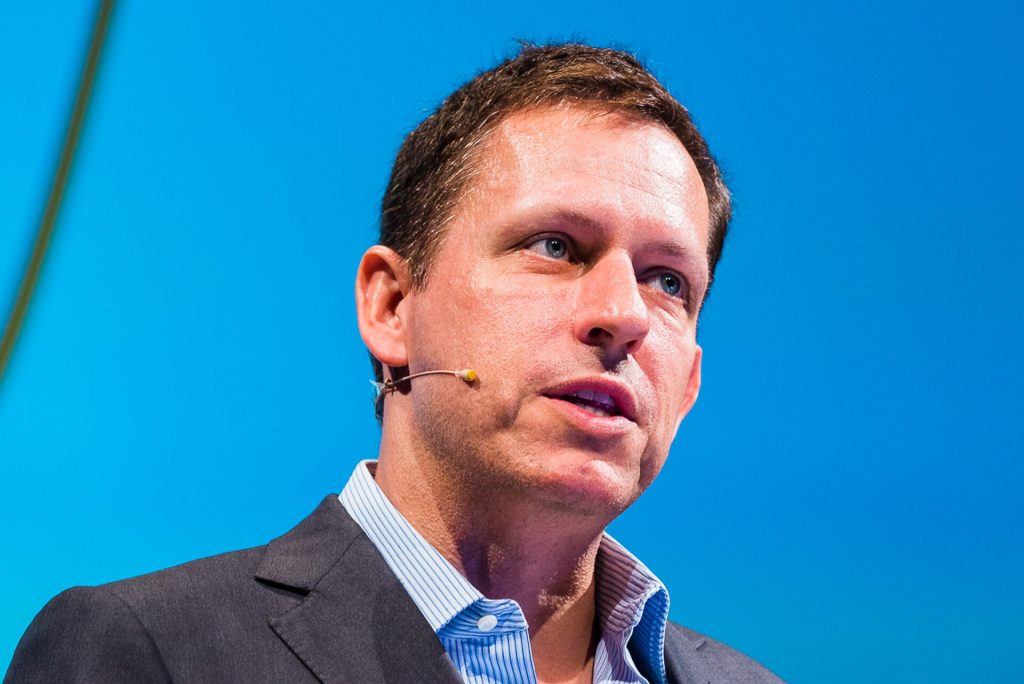
On the evening of 24 September 2026, in a room bathed in blue and violet light on the top floors of the Axel Springer tower in Berlin, Europe’s largest newspaper publisher handed its highest honour to Peter Thiel. The PayPal and Palantir co-founder thanked his hosts with a speech in which he wondered aloud why so much of the media had turned into what he called a kind of left-wing hate factory. A few floors below, more than 200 protesters had gathered outside, some of them dressed as Gandalf, under a banner reading “Thiel Shall Not Pass”.
For most English-speaking readers, the name on the award means little. The company behind it means more than they might think. Axel Springer owns Politico, Business Insider and, since this year, The Telegraph. The man who runs it, Mathias Döpfner, is one of the most powerful media executives in the Western world and one of the least known outside Germany. This is an attempt to explain who he is, why he chose Thiel, and what connects the two men beyond a shared taste for provocation.
Who is Mathias Döpfner
Döpfner, born in 1963, trained as a music critic and journalist, edited several newspapers and became editor-in-chief of Springer’s broadsheet Die Welt in 1998. Within four years he was running the entire company. He has been its chief executive ever since, which makes him one of the longest-serving media CEOs in Europe.
What sets him apart from a normal chief executive is ownership. After private equity firm KKR exited in 2025 and the company was restructured, Döpfner and Friede Springer, widow of the founder, together hold 95 percent of the company. The voting rights attached to Friede Springer’s shares have been bound to Döpfner since 2020. Springer does not publish the exact split between the two. In practical terms, one man now controls Bild, Germany’s largest tabloid, Die Welt, Politico, Business Insider and The Telegraph, with no meaningful outside shareholder to answer to.
Germans have a clearer picture of his politics than Americans or Britons do, largely because of a leak. In April 2023 the weekly Die Zeit published a cache of Döpfner’s private messages and emails. In them he described East Germans as “either communists or fascists”, dismissed most journalists covering the pandemic as uncritical propagandists and argued that warmer climates had always been good for civilisation. More consequential were his messages to Julian Reichelt, then editor of Bild, in the run-up to the 2021 federal election. Döpfner repeatedly asked whether the paper could do more for the pro-business FDP. Two days before the vote he wrote “Please strengthen the FDP”. Springer’s own code of conduct states that management leaves editorial decisions entirely to the newsroom.
Döpfner called the texts out-of-context fragments and denied improper influence. The fallout was real enough that journalists at Die Welt set up an editorial committee to protect their independence.
Since then, his course has become more explicit. According to the US media newsletter Status, Springer completed its purchase of The Telegraph, explored deals for right-leaning outlets including The Free Press and The Dispatch, and cultivated ties with the Trump White House, including meetings with chief of staff Susie Wiles. Döpfner reportedly offered around 120 million dollars for Bari Weiss’s The Free Press in 2025 and lost out to Paramount, which made Weiss editor-in-chief of CBS News. This year he invited her to speak at the Thiel ceremony.
A prize for the people Springer needs
The Axel Springer Award was created in 2016. Its first recipient was Mark Zuckerberg, followed over the years by Tim Berners-Lee, Jeff Bezos, Elon Musk, Volodymyr Zelenskyy, Satya Nadella and Sam Altman. The prize carries no money. What it carries is access.
The German transparency group LobbyControl published an investigation into Springer’s event business a week before the ceremony. Its argument is that the award is one of a series of exclusive formats in which a media company also acts as a networking broker between tech executives, investors and politicians. Springer’s marketing arm advertises its Welt economic summit with promises of an exclusive circle of decision-makers and access to politics. This year’s edition featured Chancellor Friedrich Merz and much of his cabinet alongside executives from Rheinmetall, Airbus and Deutsche Bank. Springer told LobbyControl that no access is ever sold, that the award ceremony is supported by sponsors, and that an award is not an endorsement. It declined to say how much of its profit comes from events.
The problem is not a single prize. A company that hands awards to the most powerful technology executives in the world is also the company whose newsrooms are supposed to report on them critically. Springer insists the two are strictly separated. The Zeit leak showed what that separation can look like in practice.
Springer cites PayPal, early investments in Facebook and the founding of Palantir. Döpfner said Thiel “reminds us that progress requires courage and nonconformism”. The company’s official citation also credits Thiel with a contribution to the resilience of democracies.
The man on stage
Thiel was born in Frankfurt in 1967 and moved to the United States as a child. His record as an investor is not in dispute. His record on democracy and on the press is the reason this award became a scandal.
In 2009 he wrote an essay for the Cato Institute’s online journal containing the sentence that has followed him ever since: “I no longer believe that freedom and democracy are compatible.” In Berlin he called it a hastily typed piece. He has not retracted the argument behind it.
His relationship with journalism is more concrete. In 2007 the gossip site Gawker published a piece about his sexuality. Years later, Thiel secretly financed the lawsuit that the wrestler Hulk Hogan brought against Gawker over a leaked sex tape. Hogan won a 140 million dollar verdict in 2016 and Gawker went bankrupt. Only afterwards did it become public who had paid for the case. This spring Thiel backed a new start-up called Objection, founded by the lawyer who designed the Gawker strategy. For a fee of around 2,000 dollars, anyone aggrieved by a news story can have it judged by an “AI jury”, which assigns the reporter a score.
Palantir, the surveillance and data analytics company he co-founded, is used by intelligence services, militaries and police forces. In Germany, Bavaria, Hesse, North Rhine-Westphalia and Baden-Württemberg have opted for its police software Gotham, despite years of criticism from data protection authorities and civil liberties groups.
What connects the two men
Springer presents the award as an editorial choice about a notable entrepreneur. The public record suggests a closer relationship than that.
Palantir’s chief executive Alex Karp is, by Döpfner’s own account, a good friend whom he has known since 2003. Karp sat on Springer’s supervisory board in 2018 and 2019 while Döpfner was CEO, and later on the shareholder committee Döpfner chaired. Springer is also a Palantir customer and uses its Foundry software. Döpfner has interviewed Karp several times, most recently in July 2026 for his own podcast, without disclosing the business relationship to viewers.
The closest link runs through Döpfner’s son. Moritz Döpfner worked for a time at Thiel Capital, Thiel’s family office. According to the German business magazine manager magazin, Thiel then invested 50 million dollars in Moritz Döpfner’s own venture capital fund. Media reports say both funds hold stakes in the Berlin drone maker Stark. None of this appeared in Springer’s announcement of the award.
Who was in the room
The Berlin daily taz reported that the audience included Karp, former Welt editor-in-chief Ulf Poschardt and Bavarian premier Markus Söder, whose state police force runs on Palantir software. Döpfner opened by mocking his critics, calling his own building the epicentre of evil and a right-wing conspiracy. Referring to the protesters, he suggested the event would have gone off without complaint if Springer had invited antisemites, Islamists and organised crime bosses instead.
Thiel then praised Döpfner and Weiss as rare dissenting voices in a one-sided media landscape. Midway through the ceremony, according to Springer, an employee of a contractor walked onto the stage with a protest banner.
The dissent came from inside
The loudest objection did not come from activists. On 22 September more than 120 journalists at Politico and Business Insider, in both the US and Europe, sent Döpfner a letter objecting to the award. It was the first joint action by staff of the two newsrooms. They cited Gawker and Objection as evidence of what they called Thiel’s documented history of undermining press freedom, and quoted their employer’s own website back at it, which describes freedom as “our guiding principle”. According to the German journalists’ union publication M, there has been no reply.
The German Journalists’ Association DJV had already condemned the choice in July. Its chairman Mika Beuster described Thiel as a figurehead of the American libertarian movement who tramples on democratic rules, and said the award was incompatible with Springer’s stated values. Inside the Springer tower, anonymous notes against the award were posted in a lift. Döpfner dismissed them as a single anonymous action.
Springer’s defence
The company’s position deserves to be stated fairly. Springer argues that an award recognises economic and technological impact, not political views, and that honouring someone controversial opens room for critical questions rather than closing it. It points to its editor-in-chief principle, under which newsrooms alone decide what is published. Thiel did take questions on stage, and he did distance himself, at least rhetorically, from his 2009 essay.
But the defence rests on a separation that Springer’s own recent history has undermined. The chief executive who assures readers that business and journalism are kept apart is the same chief executive who asked his tabloid editor to strengthen a party before an election. The company that says an award is not an endorsement chose a laureate whose family office invested in the chief executive’s son’s fund, and did not mention it.
Nothing described here is illegal. There is no rule obliging a media owner to disclose private financial ties to the people his company honours, no requirement to publish what sponsors pay for access to events, and no independent body that checks whether a newsroom can still report freely on its owner’s friends. Politico and Business Insider are read by the people who run Washington and Wall Street. Readers of both are entitled to know who owns them, and what that owner stood on stage to celebrate.
Sources
- taz, Verleihung des Axel-Springer-Awards: Peter Thiel, der Linkenversteher, 25 September 2026
- Tagesspiegel/dpa, Thiel kritisiert Teile der Medien als “linke Hassfabrik”, 24 September 2026
- t-online, Springer-Verlag ehrt Milliardär, 25 September 2026
- LobbyControl, Axel Springer und die Techmilliardäre, 18 September 2026
- manager magazin, Peter Thiel: 50 Millionen Dollar für den Risikokapitalfonds von Mathias Döpfners Sohn
- Status, Döpfner and Bari’s Toast to Thiel, 20 July 2026
- TheWrap, Business Insider, Politico Staffers Protest Over Peter Thiel Award, September 2026
- Talking Biz News, Business Insider, Politico staffs protest Thiel award, September 2026
- M – Menschen Machen Medien (ver.di), Preis für rechten Tech-Bro Peter Thiel, 25 September 2026
- kress, DJV attackiert Springer-Award für Peter Thiel, 17 July 2026
- Handelsblatt/dpa, Umstrittener Unternehmer bekommt Springer-Award, September 2026
- Legal Tribune Online, Döpfner interference violates Springer code
- Prospect, How will the Telegraph cope with its German owners?, March 2026
- The Irish Times, German media mogul’s leaked texts cause ructions in Berlin, 14 April 2023
- Peter Thiel, The Education of a Libertarian, Cato Unbound, 13 April 2009
- TechCrunch, Freedom of the Press Foundation will preserve Gawker’s archives, 1 February 2018
About Res.Publica
Res.Publica is a two-person project. No paywall, no ads, no investors. Every article is built on primary sources, and every source is linked.
Join the discussion on Reddit, support the work on Buy Me a Coffee, or explore the data in the Res.Publica app and sign up for the newsletter.