
COP31’s blockers produce more CO2 than the entire EU emits
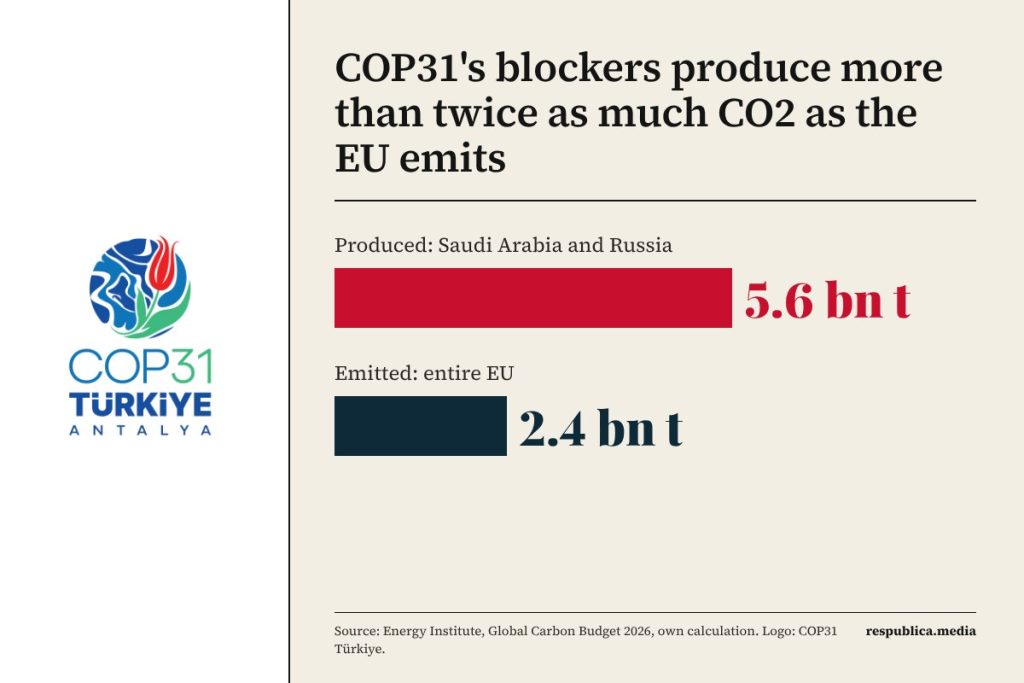
The COP31 climate summit in Antalya ended without a final text, the first time since Copenhagen in 2009. It broke down over one question: whether oil, gas and coal could be named in the text. Our own calculation shows why that question costs some countries so much. In 2024, Saudi Arabia and Russia produced fossil fuels containing 5.6 billion tonnes of CO2. The entire EU emitted 2.4 billion tonnes in the same year.
Res.Publica, November 23, 2026.
After two weeks and two days of overtime, COP31 president Murat Kurum told the plenary on Sunday that there was no agreement on the draft. The decisions were not adopted. According to UN News, it was the longest-running UN climate summit on record. Earlier decisions, including the 2023 Dubai call to transition away from fossil fuels, remain in force. Nothing new was added.
Who blocked what
According to negotiators cited by i24NEWS and Bloomberg, Saudi Arabia led the opposition to any reference to fossil fuels. Its representative spoke for the 22-member Arab Group. Russia backed the position, with a Russian delegate citing national security, Bloomberg reports. Instead of a roadmap away from oil and gas, Saudi Arabia pushed for targets on carbon capture and storage. In the plenary it argued that Arab states are responsible for only a small share of historical emissions.
The presidency’s second draft then dropped the words oil, coal and fossil. The EU, Norway, Panama, Vanuatu and the Marshall Islands refused to endorse it, as did many members of the Alliance of Small Island States. The EU called a text without any reference to fossil fuels “unconscionable”, according to UN News. German environment minister Carsten Schneider called it unacceptable. According to Joyn/newstime, more than 130 countries backed a clear transition away from fossil fuels. The summit failed in two steps: the producer countries around Saudi Arabia and Russia got oil and gas removed from the draft, and the EU and others then rejected that text. Because COP decisions require consensus, there is now no text at all.
No source gives an exact number of blocking countries. Australia’s chief negotiator Chris Bowen said only that “other parties” had threatened a veto, Bloomberg reports. Saudi Arabia speaking for the Arab Group does not mean all 22 members actively backed the line; about half of them produce little oil or gas. And not pushing for a phase-out is not the same as blocking it: India raised concerns on behalf of a group including China, Iran and Indonesia, but according to Business Standard still agreed to the text in the end.
The calculation: production instead of emissions
Climate accounting counts CO2 where fuel is burned. A country that exports its oil shows up in the buyers’ statistics, not its own. So we ran the numbers from the other side: how much CO2 is contained in the oil, gas and coal a country pulled out of the ground in 2024.
Production data come from the Energy Institute, as compiled by Our World in Data. We converted them using the IPCC default emission factors for crude oil, natural gas and bituminous coal. Domestic emissions come from the Global Carbon Budget 2026.
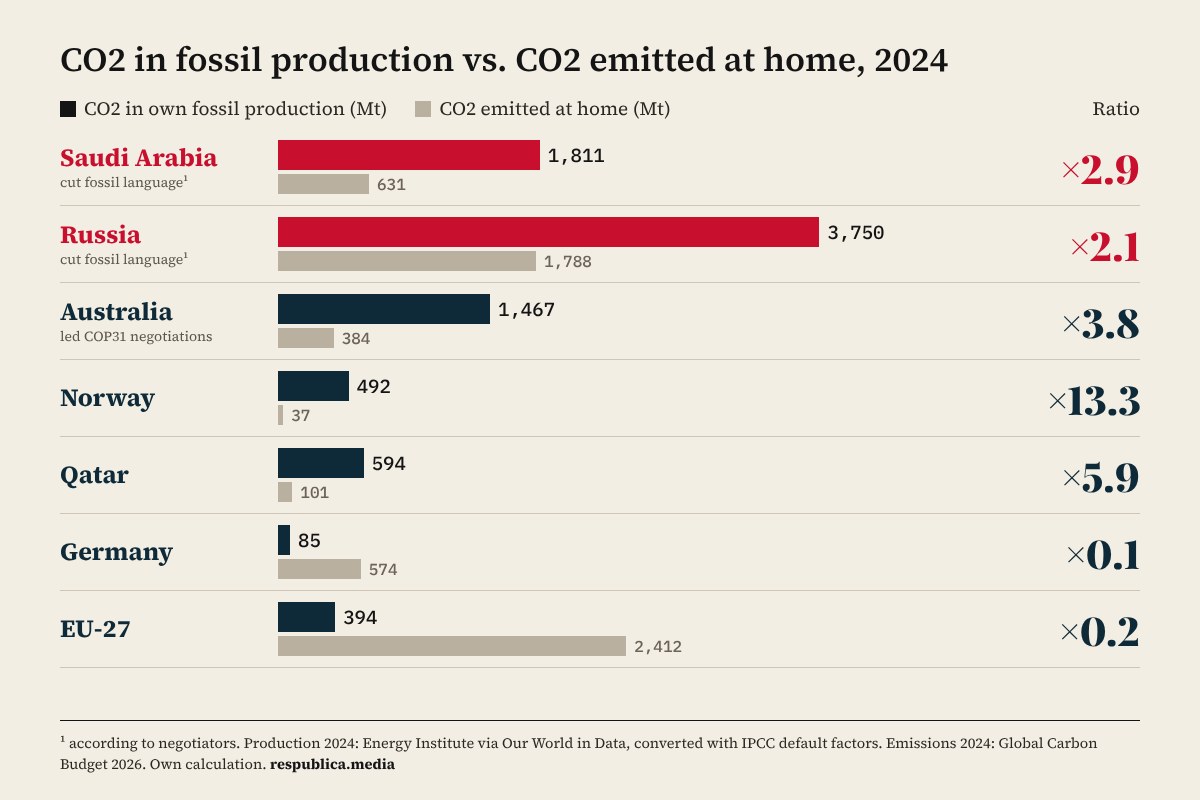
Saudi Arabia produces almost three times as much CO2 as it emits: 1.8 billion tonnes against 631 million. Russia produces just over twice as much, 3.8 billion against 1.8 billion. Together that is 5.6 billion tonnes. The EU emits 2.4 billion and produces only a sixth of that itself. The rest is imported.
Two countries dig up more than twice as much CO2 as the entire EU puts into the air.
The pattern is not limited to the blockers. Norway produces 13 times as much CO2 as it emits, and still rejected the watered-down text. Qatar produces six times as much. Australia, which led the negotiations, mainly mines coal and produces almost four times its own emissions. Germany sits at a tenth.
- Saudi Arabia: 1,811 Mt produced, 631 Mt emitted, ratio 2.9
- Russia: 3,750 vs. 1,788 Mt, ratio 2.1
- Australia: 1,467 vs. 384 Mt, ratio 3.8
- Norway: 492 vs. 37 Mt, ratio 13.3
- Qatar: 594 vs. 101 Mt, ratio 5.9
- Germany: 85 vs. 574 Mt, ratio 0.1
- EU-27: 394 vs. 2,412 Mt, ratio 0.2
What the numbers show, and what they don’t
The figures are an approximation. IPCC factors are averages, lignite releases more CO2 than hard coal, and some oil and gas ends up in plastics rather than engines. As a check, the same method gives 39.5 billion tonnes for the whole world. Actual emissions in 2024 were 38.6 billion tonnes according to the Global Carbon Budget, a gap of just over two percent.
The calculation does not assign blame. Without buyers there would be no sales, and Europe is among the largest buyers. It shows something else: who loses most from a phase-out. Saudi Arabia burns only about a third of what it produces, Russia just under half. The rest is exported. Norway shows that production alone does not explain how countries vote. But it does explain why a single word like “oil” can sink a conference of 200 countries.
What happens next is open. The next climate conference, COP32, takes place in Addis Ababa in November 2027. According to Joyn/newstime, around 30 countries have presented or announced their own plans to phase out coal, oil and gas, and a meeting in Tuvalu is planned for July.
Updated November 23, 2026: the sequence of the collapse is described more precisely.
Sources
- UN News, COP31 ends without climate pact, November 22, 2026: https://news.un.org/en/story/2026/11/1168855
- Bloomberg via Rigzone, COP Crumbles as Oil Nations Reject Fossil Fuel Language, November 23, 2026: https://www.rigzone.com/news/cop_crumbles_as_oil_nations_reject_fossil_fuel_language-23-nov-2026-185142-article
- Business Standard, COP31 climate talks collapse, November 23, 2026: https://www.business-standard.com/world-news/cop31-climate-talks-collapse-eu-russia-arab-states-fossil-fuels-finance-126112300457_1.html
- i24NEWS, COP31 ends without a deal after dispute over coal, oil and gas: https://www.i24news.tv/en/news/international/environment/artc-cop31-ends-without-a-deal-after-dispute-over-coal-oil-and-gas
- taz, COP31 in Antalya: Weltklimakonferenz scheitert (German): https://taz.de/COP31-in-Antalya/!6232152/
- Joyn/newstime, Klimagipfel in Antalya gescheitert (German): https://newstime.joyn.de/themen/politik/klimagipfel-in-antalya-gescheitert-220560
- Energy Institute, Statistical Review of World Energy, compiled by Our World in Data: https://github.com/owid/energy-data
- Global Carbon Budget 2026, compiled by Our World in Data: https://github.com/owid/co2-data
- IPCC 2006 Guidelines for National Greenhouse Gas Inventories, Volume 2, Chapter 1, Table 1.4: https://www.ipcc-nggip.iges.or.jp/public/2006gl/pdf/2_Volume2/V2_1_Ch1_Introduction.pdf
Read next
 World 175 countries vote against femicide. The US abstains, side by side with Russia and Belarus
18.11.2026
 Breaking News The Cockroach Party Marches on Parliament
20.07.2026
 Breaking News He Was Elected to Clean Up FIFA. A Decade Later, the President Is More Powerful Than Blatter Ever Was.
24.06.2026

Luca Calcagno is a journalist and the founder and editor of Res.Publica. He studies political science (B.A.) with a focus on politics, law and sociology, and analyses public data on the Bundestag, the German lobby register, elections and democracy. His work covers German, European and international politics.