
Trump says climate science is “GONE!” Earth just broke its heat record
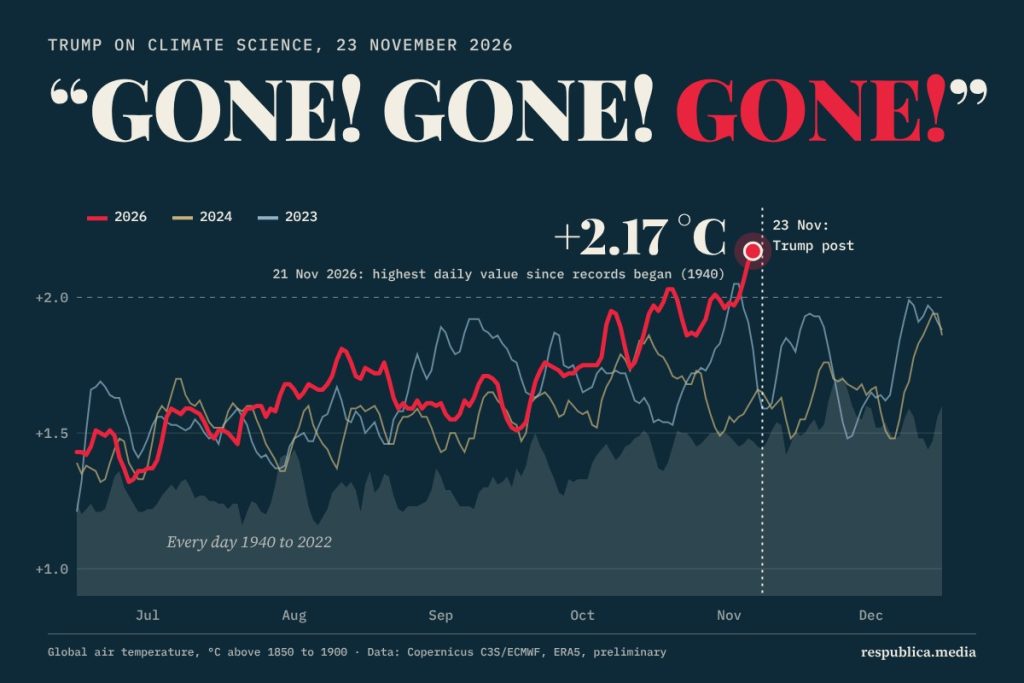
Global air temperature, daily values. Data: Copernicus C3S/ECMWF, ERA5 (CC BY 4.0). Own chart.
On Monday, Donald Trump declared that climate science had been “debunked, withdrawn, and taken down” by the UN’s climate panel. Nothing of the sort happened. And two days before his post, the planet set a new record: on November 21, global air temperature was 2.17 °C above pre-industrial levels, the highest daily value since measurements began.
Res.Publica, November 23, 2026.
“Their Climate Science has now been debunked, withdrawn, and taken down by the UN IPCC. […] No more catastrophic predictions. GONE! GONE! GONE!”
Donald Trump on Truth Social, November 23, 2026
What Trump claims
According to Trump, the Intergovernmental Panel on Climate Change (IPCC) has “determined” that its own projections “are not reliable” and has “withdrawn them”. He does not name a report, a paper or a date. It is the second time this year he has made this claim. In May, he posted that the UN’s “TOP Climate Committee” had admitted its projections were “WRONG! WRONG! WRONG!”
The IPCC has not withdrawn, retracted or taken down anything. Its last full assessment report, AR6, is still online and still in force. The next one, AR7, is being written.
What actually happened
Trump is distorting a technical decision from April 2026. A group of climate modellers called ScenarioMIP, which plans the emissions scenarios that climate models are run with, published the scenario set for the next generation of models (CMIP7). One scenario did not make the cut: the extreme high emissions pathway known as RCP8.5, or SSP5-8.5 in its newer version.
The reason is in the paper itself. Because of falling costs for renewables, new climate policies and recent emissions trends, the authors write, those extreme emission levels “have become implausible”. RCP8.5 assumed, among other things, a massive expansion of coal power that has not happened.
- Dropped: one extreme scenario (RCP8.5/SSP5-8.5), because the world is no longer on that path.
- Not dropped: the physics. How much the planet warms per tonne of CO2 is unchanged.
- Who decided: a modelling group (ScenarioMIP), not the IPCC. The IPCC says it “does not own” these scenarios.
- New highest scenario: about 3.3 °C of warming by 2100 (range 2.5 to 4.4 °C).
- New lowest scenario: peaks around 1.7 °C. None of the new scenarios keeps warming at 1.5 °C without a significant overshoot.
The IPCC itself responded in May when the claim first went around. The paper “belongs to the broader body of scientific literature”, the panel said, and the IPCC “does not own the scenarios”. Robert Vautard, co-chair of the IPCC working group on the physical science, put it more briefly: “IPCC does not produce scenarios.”
Why the worst case disappeared
This is the part Trump leaves out. The worst case was not dropped because the science was wrong. It was dropped because the world changed course. “Back in 2010, RCP8.5 wasn’t an implausible future, we’ve now made it an implausible future,” Chris Smith of the International Institute for Applied Systems Analysis (IIASA), a co-author of the scenario paper, told Carbon Brief. Detlef van Vuuren of Utrecht University, its first author, says the world is now heading for 2.5 to 3 °C of warming by 2100.
That is less than the old worst case. It is still far above the Paris goal. And the same update that removed the most extreme scenario also removed the most optimistic one: according to van Vuuren, there is no longer any scenario that reaches 1.5 °C with only a limited overshoot. In other words, the update did not make the outlook milder. It made it more realistic, in both directions.
Meanwhile, the thermometer
Trump posted on November 23. In the days before, the planet broke its daily temperature record three times in a row, according to Copernicus, the EU’s climate monitoring service:
- November 19: 2.06 °C above pre-industrial (1850 to 1900)
- November 20: 2.13 °C
- November 21: 2.17 °C (preliminary)
The previous record, 2.05 °C on November 17, 2023, had stood for three years. 2026 has now had six days at or above 2 °C. In 2023 there were two, in 2024 three.
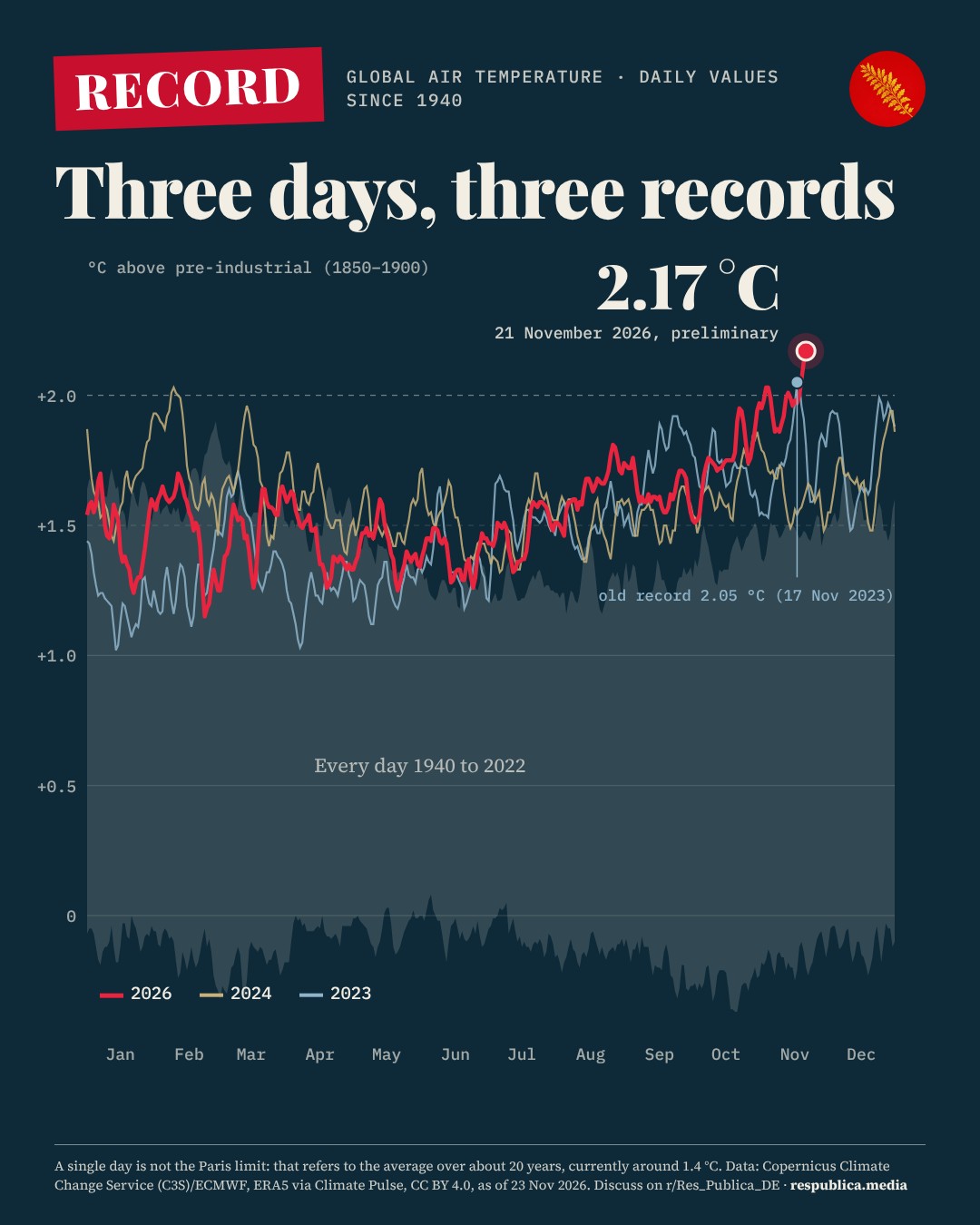
One honest caveat, because this number will be shared out of context: a single day above 2 °C does not mean the world has broken the Paris limit. That limit refers to the average over about 20 years. Human-caused warming stood at about 1.36 °C in 2024, according to the most recent update of the Indicators of Global Climate Change. The direction is the same, though, and it is going up.
The timing
The record days fell exactly into the final days of the UN climate conference COP31 in Antalya. On November 22, the conference ended without a final text, the first time since Copenhagen in 2009. Oil-producing states had pushed any mention of fossil fuels out of the draft; the EU and others then rejected what was left. We looked at who blocked and how much CO2 these countries pull out of the ground themselves.
One day later, the US president announced that climate science was gone. The data from the days before say otherwise.
Sources
- Donald Trump, Truth Social, Nov 23, 2026: https://truthsocial.com/@realDonaldTrump/posts/117667276373895254
- Carbon Brief, Factcheck: Trump’s false claims about the IPCC and “RCP8.5” climate scenario, May 19, 2026 (updated May 21): https://www.carbonbrief.org/factcheck-trumps-false-claims-about-the-ipcc-and-rcp8-5-climate-scenario
- Van Vuuren et al. (2026), The Scenario Model Intercomparison Project for CMIP7, Geoscientific Model Development 19, 2627: https://doi.org/10.5194/gmd-19-2627-2026
- Eos, Why the IPCC seems poised to eliminate its most extreme emissions scenario, May 19, 2026: https://eos.org/research-and-developments/why-the-ipcc-seems-poised-to-eliminate-its-most-extreme-emissions-scenario
- European Commission, DG Climate Action, 5 things you should know about climate scenarios, June 5, 2026: https://climate.ec.europa.eu/news-other-reads/news/5-things-you-should-know-about-climate-scenarios-2026-06-05_en
- Copernicus Climate Change Service (C3S)/ECMWF, Climate Pulse, ERA5 daily global values: https://pulse.climate.copernicus.eu/
- Climate Pulse dataset (CSV, column anom_1850_1900): https://sites.ecmwf.int/data/climatepulse/timeseries/csv/daily/timeseries_era5_t2m_daily_global.csv
- Copernicus, method for anomalies relative to 1850 to 1900: https://climate.copernicus.eu/climate-bulletin-about-data-and-analysis
- Forster et al. (2025), Indicators of Global Climate Change 2024, Earth System Science Data 17, 2641: https://essd.copernicus.org/articles/17/2641/2025/
- Res.Publica, COP31 blockers and fossil production: https://respublica.media/en/cop31-blockers-fossil-production-co2/
Read next
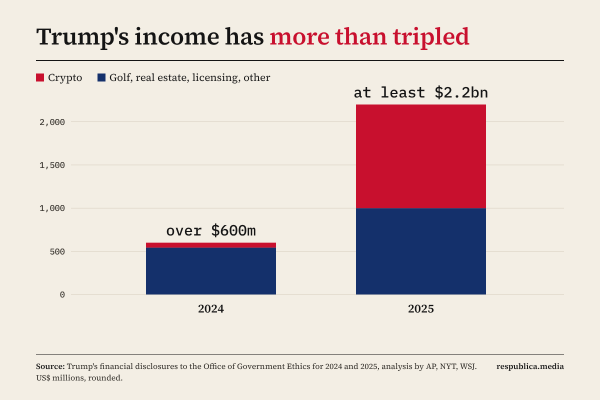 Geopolitics The business of the presidency: how Trump and his family profit from the office
07.11.2026
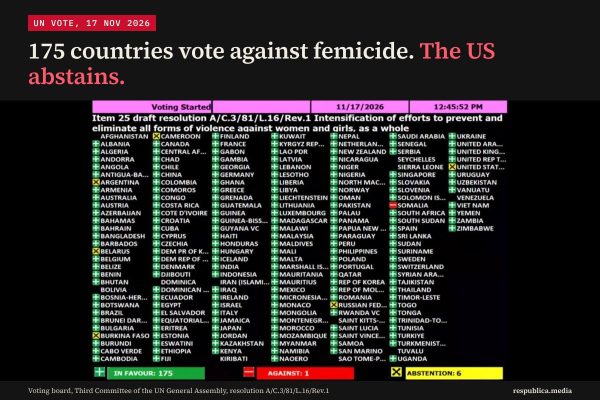 World 175 countries vote against femicide. The US abstains, side by side with Russia and Belarus
18.11.2026
 Breaking News He Was Elected to Clean Up FIFA. A Decade Later, the President Is More Powerful Than Blatter Ever Was.
24.06.2026

Luca Calcagno is a journalist and the founder and editor of Res.Publica. He studies political science (B.A.) with a focus on politics, law and sociology, and analyses public data on the Bundestag, the German lobby register, elections and democracy. His work covers German, European and international politics.