
Argentina under Milei: record oil output, 274,000 fewer formal jobs
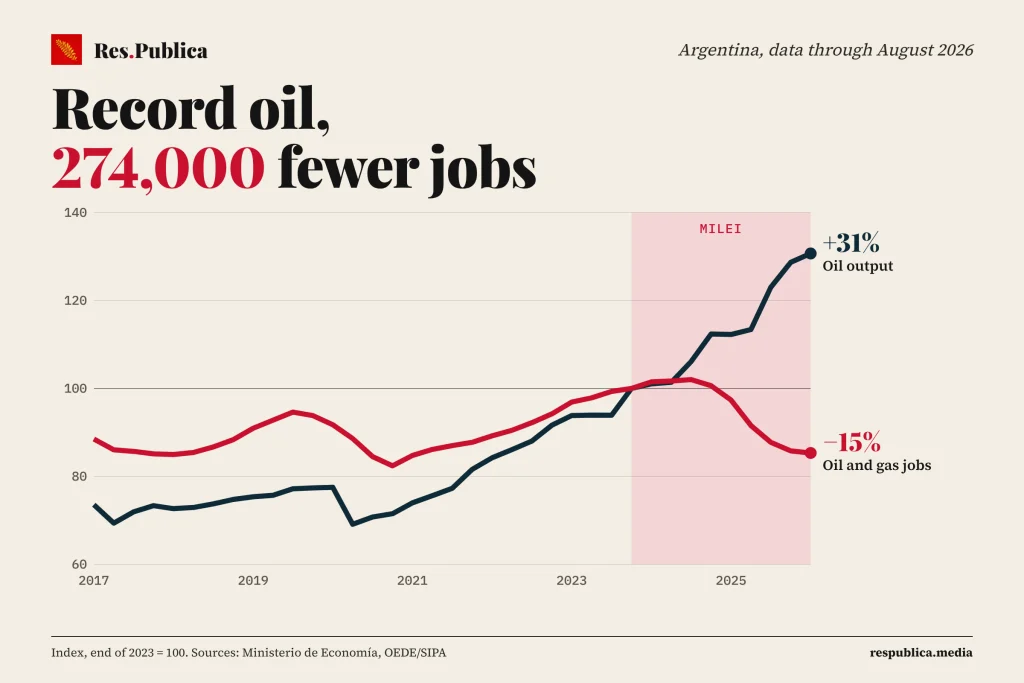
Argentina is pumping more oil than ever before. At the same time the country has lost about 274,000 registered private-sector jobs since President Javier Milei was elected. We analysed the official social security data for all 24 provinces and 25 sectors. The result: 21 provinces have lost jobs, and even in the boom province of Neuquén fewer people work in oil and gas extraction today than at the end of 2023. At the ballot box, none of this has hurt Milei so far.
Res.Publica, 25 November 2026.
The basis is SIPA, the social security register that Argentina’s Labour Secretariat publishes every month. It counts jobs with pension contributions. In November 2023, the month Milei was elected, it recorded 6.37 million private-sector employees. In August 2026 it was 6.10 million. That is 274,000 fewer, a drop of 4.3 percent and the lowest level since March 2022. The figure has fallen for 15 months in a row since June 2025.
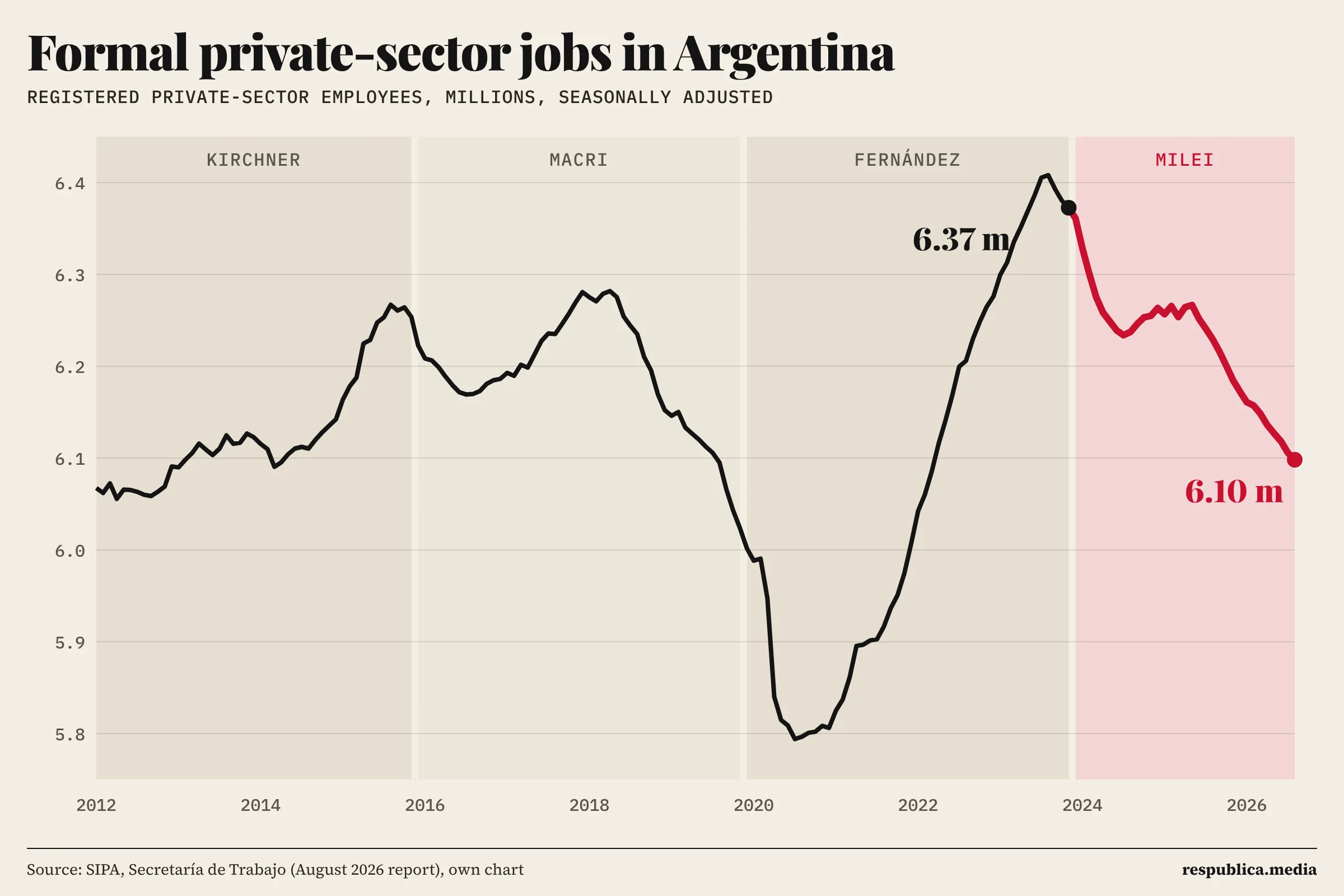
Two things belong in the picture. The decline began in September 2023 under then economy minister Sergio Massa. By November, 36,000 jobs were gone before Milei took office. And job losses are nothing new in Argentina: over the full term of Mauricio Macri, 230,000 private-sector jobs disappeared. The difference is the pace. Measured from the month before inauguration, Macri stood at plus 650 jobs after 31 months and Alberto Fernández at plus 145,000. Milei was at minus 254,000 at the same point.
21 of 24 provinces are down
The national figure hides how unevenly the losses are spread. Tierra del Fuego has lost almost one in five registered private-sector jobs, Santa Cruz one in six, La Rioja one in seven. In absolute terms the province of Buenos Aires accounts for the largest share with 108,000 jobs, followed by the capital with 44,000.
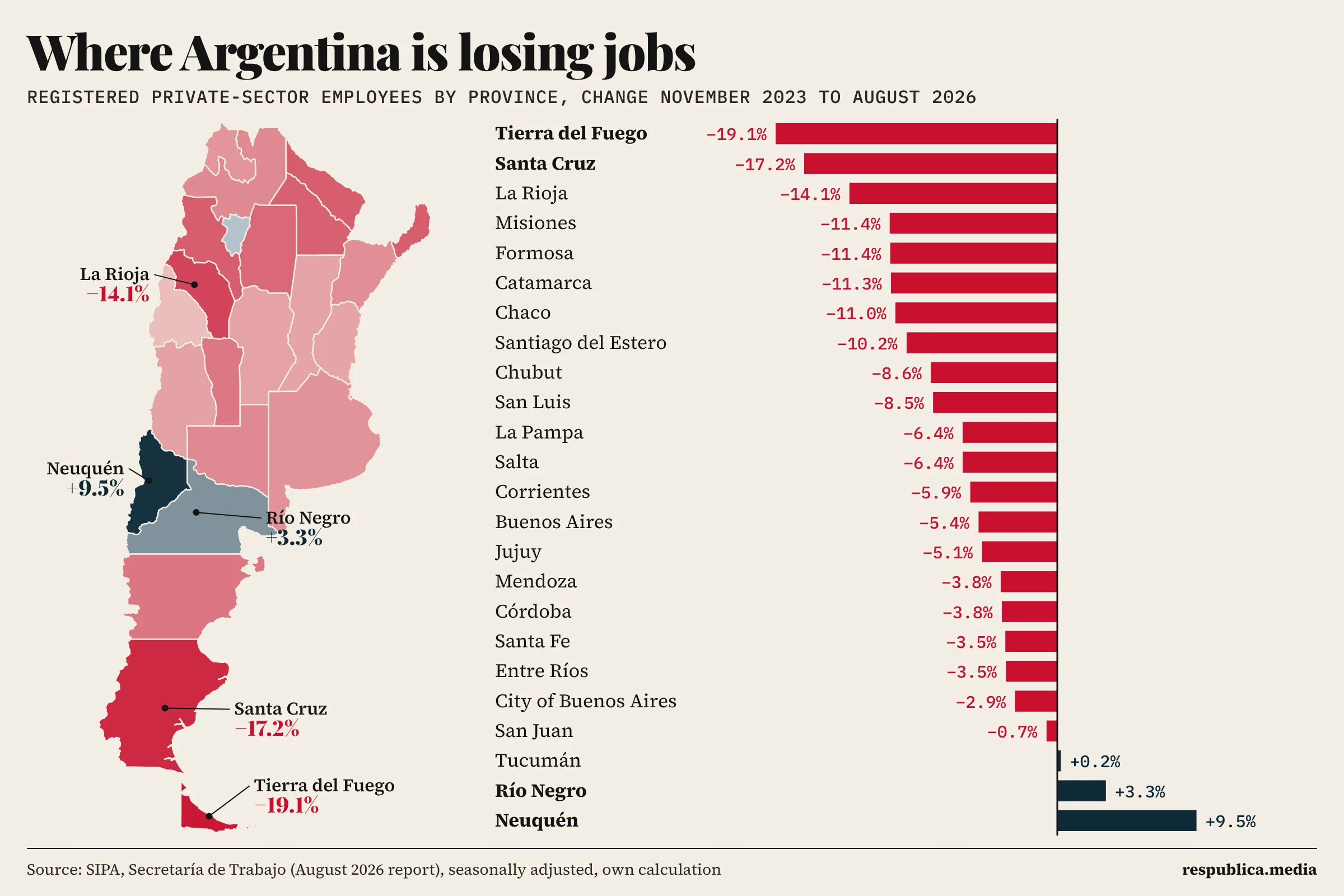
Only three provinces grew. Tucumán added 400 jobs, which amounts to a standstill. Real growth is limited to Neuquén, up 9.5 percent (13,600 jobs), and neighbouring Río Negro, up 3.3 percent. That is where Vaca Muerta lies, one of the world’s largest shale oil and shale gas deposits.
More oil, fewer oil workers
Vaca Muerta is Milei’s showcase. In September 2026 Argentina produced about 960,000 barrels of oil per day according to the economy ministry, 44 percent more than in November 2023. Roughly three in four barrels come from Neuquén. Fuel and energy exports have more than doubled: 12.5 billion dollars in the first nine months of 2026, up from 5.7 billion in the same period of 2023.
Little of that shows up in employment. This is visible in the Labour Secretariat’s statistics on jobs by province and industry. In the five producing provinces of Neuquén, Chubut, Santa Cruz, Mendoza and Río Negro, 54,300 people worked in oil and gas extraction at the end of 2023, service companies included. By the end of 2025 it was 46,600. That is a drop of 14 percent, while output rose 29 percent. Put differently, output per worker is up by about half.
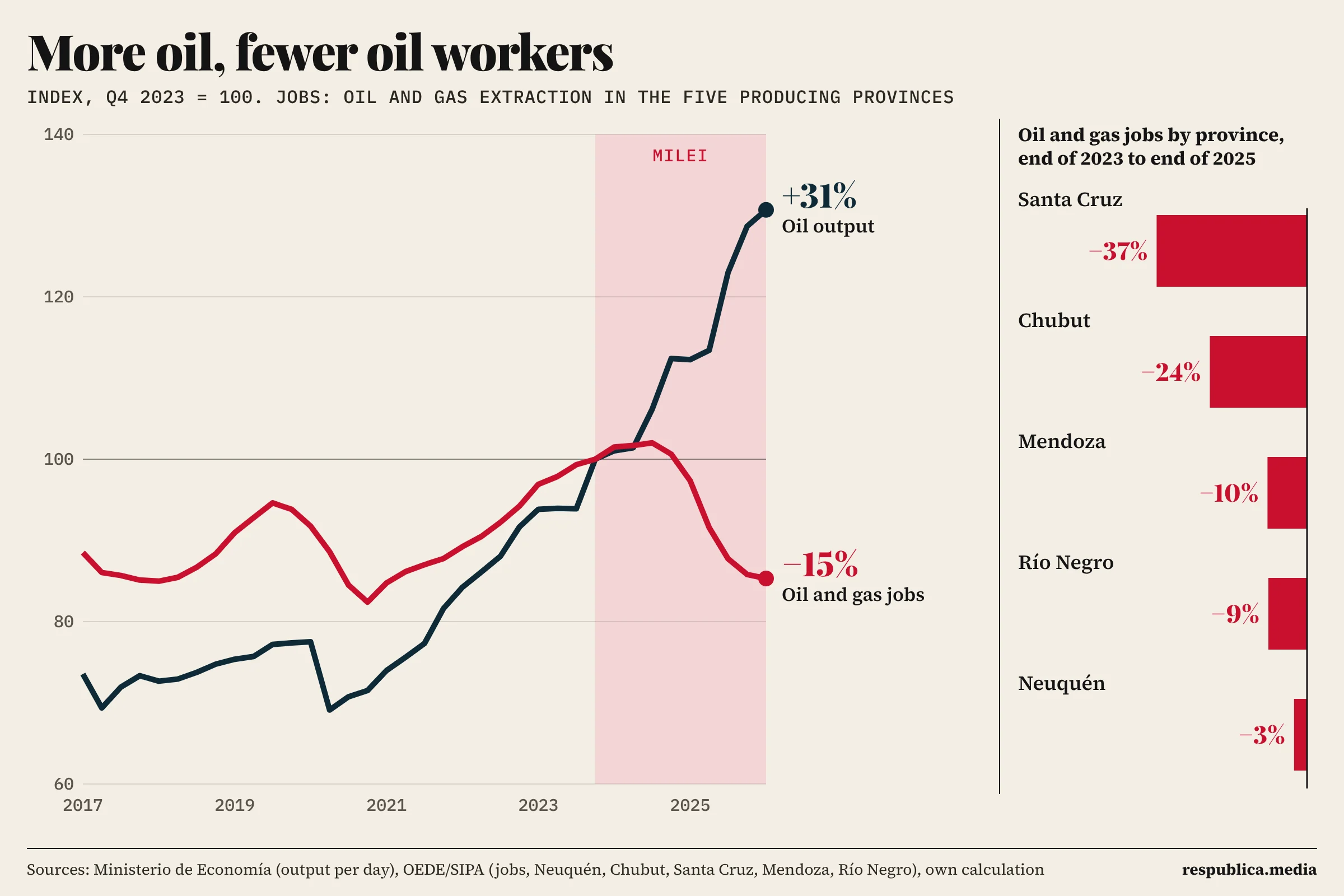
The old fields around the San Jorge Gulf are hit hardest. In Santa Cruz, oil and gas jobs fell from 8,450 to 5,341, a drop of 37 percent. In Chubut they fell from 13,012 to 9,917. The majority state-owned company YPF pulled out of mature conventional fields in 2024 and 2025 to put its money into Vaca Muerta. In the Escalante district, home to the oil city of Comodoro Rivadavia, one in nine registered private-sector jobs disappeared between November 2023 and November 2025.
The finding for Neuquén itself is more surprising. Even there, oil and gas extraction employed fewer people at the end of 2025 than two years earlier: 24,904 instead of 25,724. The province did gain 5,400 private-sector jobs over that time, but in retail and wholesale (up 2,500), land transport (up 1,500) and business services (up 1,100). The boom creates work around the wells, not at them. Shale needs a lot of capital and few people.
29 percent more oil, 14 percent fewer oil workers. The boom has arrived. The jobs have not.
The provincial government itself is tempering expectations. About 100 families move to Neuquén every week, provincial minister Lucas Castelli said in July. The province creates employment, he said, but there is no surplus of work.
What the megaprojects promise
The government is betting on its incentive scheme for large investments, known as RIGI. It grants projects of 200 million dollars or more tax and currency benefits for 30 years. At the start of November 2026, 27 projects had been approved, according to an analysis reported by the newspaper Perfil. They come with pledged investments of 76 billion dollars and 133,000 jobs, direct and indirect combined.
That is fewer than two jobs per million dollars invested, and about one in oil and gas. Even if every pledge comes true, it would not make up half of the jobs lost since November 2023. Two projects are in operation so far. All job figures are company projections.
Textiles, construction, Tierra del Fuego: where the jobs are going
The largest single loss is in construction, down 64,000 jobs after the government largely halted public works. Manufacturing as a whole lost 94,000. The steepest decline is in textiles, clothing and footwear: 29,900 fewer jobs, a drop of 24.7 percent. One in four jobs is gone.
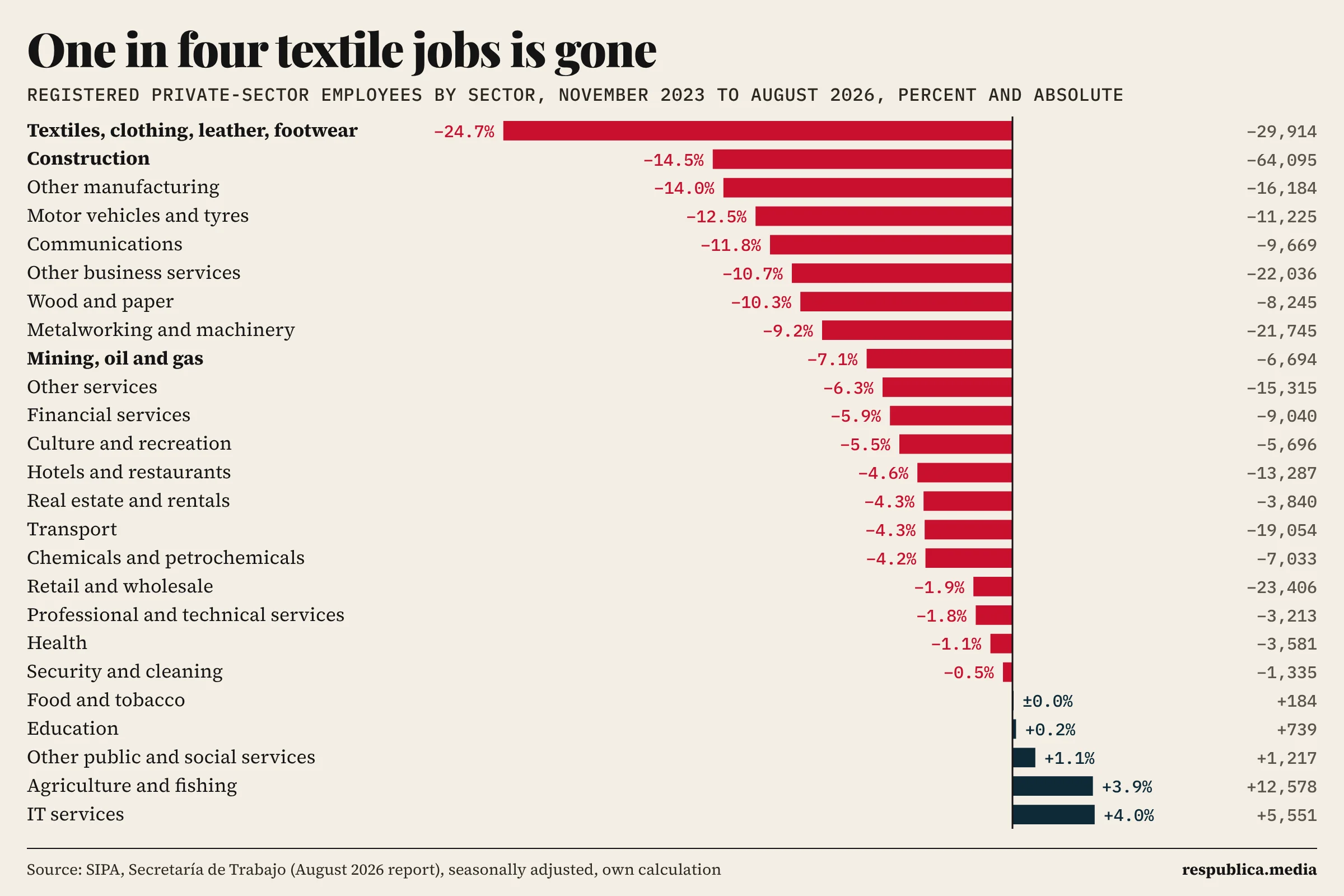
This is where Milei’s opening to imports bites. The volume of imported consumer goods in the second quarter of 2026 was 35 percent above its level three years earlier, even though total imports fell slightly. The industry association Pro Tejer reports a 46 percent rise in clothing imports (by weight) for January to September 2026 and an import share of about 70 percent of the market. Factories ran at 41 percent of capacity on average from January to August. For consumers that means lower prices. For the workshops it means short-time work and closures.
Tierra del Fuego deserves a closer look. The island lives off a special zone where phones, televisions and air conditioners are assembled. With Decree 333/2025 the government cut the import duty on phones from 16 to 8 percent in May 2025 and to zero on 15 January 2026. The electronics plants employed 8,816 people at the end of 2023 and 6,236 at the end of 2025. Most of that decline, however, came in 2024, before the tariff cut, when the recession hit demand. What the zero tariff does will only show in the coming quarters.
Where the workers go
Not every lost job means one more unemployed person. The number of self-employed people registered under the monotributo, a simplified tax regime, has risen by 201,000 since November 2023. Many carry on as drivers, traders or freelancers, mostly without paid leave, a 13th-month bonus or accident insurance. The state cut 90,000 jobs, and domestic work lost 22,000.
The government points to total employment. Deregulation minister Federico Sturzenegger said in March that 408,000 jobs were created between the third quarter of 2023 and the third quarter of 2025. His own breakdown: plus 630,000 informal and self-employed jobs, minus 222,000 formal ones. According to the statistics office INDEC, unemployment rose from 5.7 percent at the end of 2023 to 7.9 percent in the second quarter of 2026, and informality to 45 percent.
No price at the ballot box
In the legislative election of October 2025, Milei’s party La Libertad Avanza won about 41 percent nationwide and came first in 15 of 24 districts. For each province we set the job losses up to the election against the result. There is no relationship. The correlation is 0.07, which is practically zero.
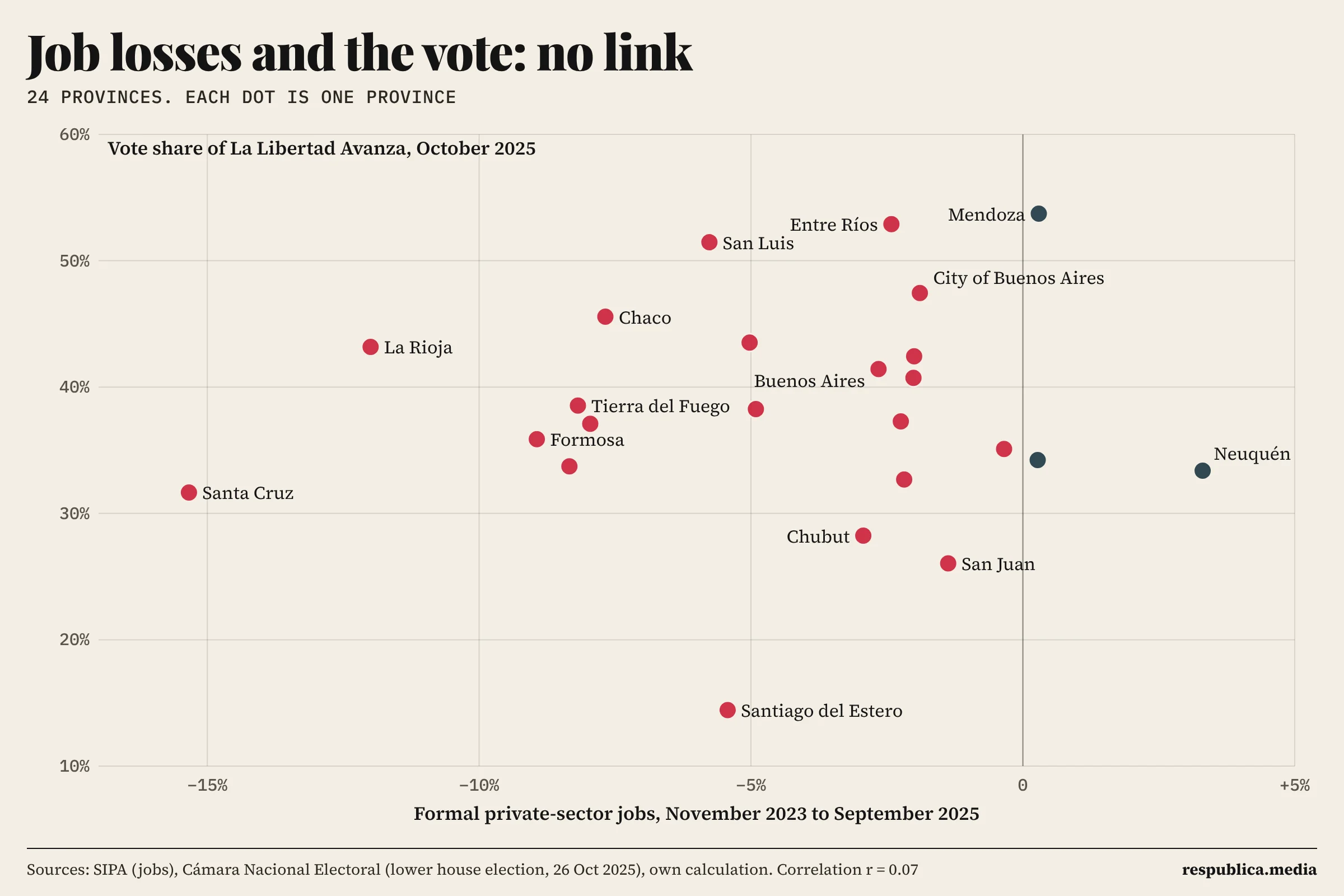
In La Rioja, 12 percent of private-sector jobs had vanished by election day, and Milei’s list took 43 percent. In Chaco, 8 percent of jobs were gone, and the party won with 46 percent. In Tierra del Fuego it came first despite the factory crisis. Conversely, in Neuquén, the only province with clear job growth, it got just 33 percent, less than Milei had received there in the first round in 2023.
This does not mean the unemployed vote for Milei. Provincial data say nothing about individual voters. What they do show is that other things decided the election, above all falling inflation. Since the vote, the job losses have accelerated: 118,000 of the 274,000 lost jobs date from the period since September 2025.
Milei’s side of the ledger
In December 2023 prices rose 25.5 percent in a single month. In October 2026 the figure was 2.2 percent, or 33 percent year on year. The poverty rate fell from 41.7 percent at the end of 2023 to about 28 percent at the end of 2025, but climbed back to 32.3 percent in the first half of 2026.
On wages, the verdict depends on the starting month. The median wage of registered private-sector employees in August 2026 was 2 percent lower in real terms than in November 2023. Measured against December 2023, after the price shock of the devaluation, the wage index is up 10 percent. That is the figure economy minister Luis Caputo cites. Economic activity in August 2026 was 2.4 percent above November 2023 and has fallen 4.4 percent since March.
Milei’s supporters argue that many of the lost jobs only existed behind tariff walls and with subsidies. Electronics assembly in Tierra del Fuego is the best-known example. What remains open is where the people from those industries and regions are supposed to work instead. So far the data say: as self-employed, informally, or not at all.
- −274,000 registered private-sector employees (November 2023 to August 2026), 15 monthly declines in a row
- 21 of 24 provinces have lost jobs, Tierra del Fuego −19%, Santa Cruz −17%
- +44% oil output since November 2023, but −14% jobs in oil and gas extraction in the producing provinces (end of 2023 to end of 2025)
- −24.7% jobs in textiles, clothing and footwear, −64,000 in construction
- +201,000 self-employed under the monotributo, −90,000 public-sector jobs
- 133,000 promised jobs from 27 megaprojects (RIGI), two in operation so far
- 2.2% monthly inflation in October 2026, down from 25.5% in December 2023
What the numbers do not show
SIPA counts jobs with social security, not people. Someone with two jobs counts twice. Informal work does not appear at all, and in Argentina that is almost half of all employment. The monthly series by province and sector are seasonally adjusted and run through August 2026. The figures on oil and gas jobs come from a second, quarterly dataset by the same agency that is not seasonally adjusted and runs through the first quarter of 2026. We therefore compare like quarters there. For small provinces the agency withholds some industry figures to protect statistical confidentiality. The district figures for Comodoro Rivadavia are labelled experimental.
Since 2012 Argentina’s formal private sector has moved between 5.8 and 6.4 million jobs, under every government. What is new under Milei is that the decline coincides with an export record. Whether oil will eventually deliver the jobs that manufacturing and construction have lost will show in the data of the coming years. So far it has not.
How much oil and gas other countries produce is covered in our analysis of the countries that blocked the COP31 climate summit. More country data on the economy and democracy is available in the Res.Publica Dashboard.
Sources
- Secretaría de Trabajo, Situación y evolución del trabajo registrado (SIPA), August 2026 report, spreadsheet with monthly series by province and sector: https://www.argentina.gob.ar/sites/default/files/trabajoregistrado_2608_estadisticas.xlsx
- Secretaría de Trabajo, labour statistics overview: https://www.argentina.gob.ar/trabajo/estadisticas
- OEDE, employment by province and industry, quarterly through Q1 2026: https://www.argentina.gob.ar/sites/default/files/provinciales_serie_empleo_trimestral_2dig_7.xlsx
- OEDE, employment by district (experimental statistics), through March 2026: https://www.argentina.gob.ar/sites/default/files/departamento_serie_empleo_remuneraciones_4.xlsx
- OEDE, regional statistics overview: https://www.argentina.gob.ar/trabajo/estadisticas/oede-estadisticas-provinciales
- Ministerio de Economía, monthly crude oil output (Datos Argentina): https://apis.datos.gob.ar/series/api/series/?ids=41.3_PC_0_A_14&limit=1000&format=csv
- INDEC, fuel and energy exports, monthly: https://apis.datos.gob.ar/series/api/series/?ids=74.3_IECE_0_M_35&limit=1000&format=csv
- INDEC, import volume index (consumer goods and total): https://apis.datos.gob.ar/series/api/series/?ids=81.2_IICIBC_0_T_48,81.2_IICING_0_T_47&limit=1000&format=csv
- INDEC, consumer prices, wage index and EMAE: https://apis.datos.gob.ar/series/api/series/?ids=148.3_INIVELNAL_DICI_M_26,149.1_SOR_PRIADO_OCTU_0_25,149.1_SOR_PUBICO_OCTU_0_14,143.3_NO_PR_2004_A_31&limit=1000&format=csv
- INDEC, unemployment rate (EPH): https://apis.datos.gob.ar/series/api/series/?ids=42.3_EPH_PUNTUATAL_0_M_30&limit=1000&format=csv
- Decree 333/2025, full text: https://www.argentina.gob.ar/normativa/nacional/norma-412953/texto
- Chequeado on Decree 333/2025: https://chequeado.com/el-explicador/eliminacion-de-aranceles-a-la-importacion-de-celulares-como-impacta-la-medida-y-cual-es-el-peso-de-los-impuestos-sobre-el-precio-final/
- 2025 election results by province, El Cronista: https://www.cronista.com/economia-politica/resultados-elecciones-2025-quien-gano-las-legislativas-provincia-por-provincia/
- Chequeado on the 2025 election: https://chequeado.com/el-explicador/elecciones-legislativas-2025-las-5-claves-del-triunfo-nacional-de-la-libertad-avanza/
- Río Negro, Neuquén output record in September 2026: https://www.rionegro.com.ar/energia/vaca-muerta-llevo-a-neuquen-a-un-nuevo-record-historico-supero-los-714-000-barriles-diarios-de-petroleo-4768076/
- Perfil, RIGI and jobs per million invested: https://www.perfil.com/economia/el-rigi-generaria-menos-de-dos-empleos-por-cada-millon-de-dolares-invertido-a40-ahrPv3V3jlt5
- El Cronista, the 27 approved RIGI projects: https://www.cronista.com/economia-politica/el-mapa-de-las-inversiones-del-rigi-cuales-son-los-27-proyectos-que-ya-tienen-luz-verde/
- Revista Anfibia, YPF’s exit from mature fields: https://www.revistaanfibia.com/la-retirada-de-ypf/
- El Extremo Sur, output in the San Jorge Gulf after YPF’s exit: https://www.elextremosur.com/nota/58808-ypf-se-fue-y-la-cuenca-del-golfo-san-jorge-sufre-por-la-baja-de-la-produccion-petrolera/
- Fundar, study on Comodoro Rivadavia and the San Jorge Gulf: https://fund.ar/publicacion/comodoro-rivadavia-y-el-fin-de-un-ciclo-hacia-una-transicion-productiva-justa-para-la-cuenca-del-golfo-san-jorge/
- iProfesional, provincial minister Castelli on Neuquén, 20 July 2026: https://www.iprofesional.com/energia/460360-neuquen-empleo-privado-oportunidades-laborales
- El Economista, employment in Neuquén, 20 July 2026: https://eleconomista.com.ar/energia/el-boom-desafia-crisis-vaca-muerta-creo-12000-empleos-puso-neuquen-frente-pais-n96808
- Economis, figures from the textile association Pro Tejer: https://economis.com.ar/industria-textil-perdio-28-818-empleos-y-cerro-1-090-empresas-desde-el-inicio-del-gobierno-de-milei/
- Infobae, Sturzenegger on employment, 13 March 2026: https://www.infobae.com/economia/2026/03/13/sturzenegger-defendio-el-modelo-economico-y-asegura-que-se-esta-creando-empleo/
- Bloomberg Línea, unemployment 7.9% in Q2 2026: https://www.bloomberglinea.com/latinoamerica/argentina/desempleo-en-argentina-alcanzo-el-79-en-el-segundo-trimestre-2026-crece-03-puntos-en-un-ano/
- Ámbito, informality 45%: https://www.ambito.com/el-desempleo-subio-79-su-nivel-mas-alto-2021-y-la-informalidad-salto-45-n6323656
- Chequeado, poverty 32.3% in H1 2026: https://chequeado.com/el-explicador/la-pobreza-aumento-al-323-en-el-primer-semestre-de-2026-y-alcanza-a-15-millones-de-personas-en-todo-el-pais/
Read next

Luca Calcagno is a journalist and the founder and editor of Res.Publica. He studies political science (B.A.) with a focus on politics, law and sociology, and analyses public data on the Bundestag, the German lobby register, elections and democracy. His work covers German, European and international politics.