
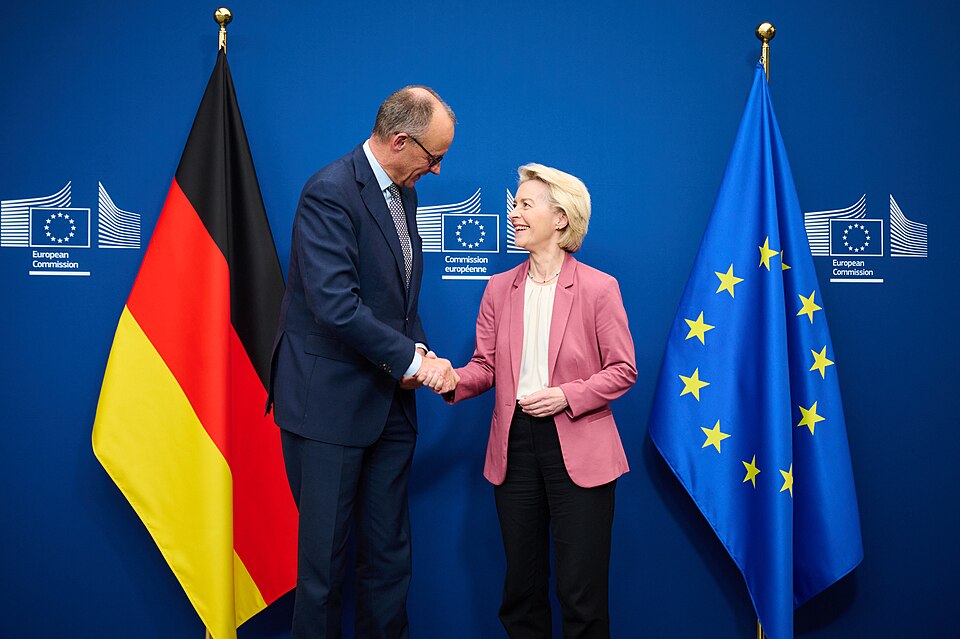
Six governments that together pay almost 40 percent of what EU member states put into the common budget have told the rest of the bloc that there will be no deal on the next seven-year budget unless it shrinks by “several hundred billion euros”. The letter, dated 28 September and signed by Friedrich Merz together with the leaders of the Netherlands, Sweden, Denmark, Austria and Finland, lands two weeks before EU leaders meet in Brussels on 15 and 16 October. Because the Multiannual Financial Framework needs unanimity, the threat is not rhetorical. “Unless the budget is cut by hundreds of billions, there won’t be an agreement this year,” a diplomat from one of the six told reporters.
The headline number the six are fighting is the European Commission’s proposal from July 2025, a budget of roughly €2 trillion for 2028 to 2034. Merz has called it “simply not affordable” and says it is about 60 percent larger than the current framework. Both numbers are correct. Neither tells you much about what the fight is actually over.
What the six are asking for
The letter does not name a target figure. It rejects the 2 percent cut floated by the Cypriot presidency in June as “far too small” and asks for spending to move toward security and defence, competitiveness, innovation and the fight against irregular migration. It also rules out new joint EU borrowing. In June, Reuters reported on an internal German government paper that put Berlin’s own target at a cut of €400 billion, about a fifth of the Commission’s proposal. The legal consultancy Matheson reports that the more cautious capitals are aiming for a ceiling closer to 1.1 percent of EU gross national income, compared with the 1.26 percent the Commission proposed.
On the other side sits a group of 17 member states, led by Spain and Italy, that wants to protect farm and regional funding, go above €2 trillion rather than below it, and keep the door open to common debt. Ireland, which holds the Council presidency until December, is expected to table its own compromise text in early October.
What the 60 percent is made of
The €2 trillion figure is in current prices, meaning seven years of expected inflation are baked in. The current framework for 2021 to 2027 was agreed at €1.07 trillion in 2018 prices, which works out at around €1.2 trillion in the money of the years it is actually spent. Comparing a 2034 euro with a 2021 euro is how you get to 60 percent.
The more useful yardstick is the share of Europe’s economy. The current framework amounts to 1.13 percent of EU gross national income. The Commission’s proposal amounts to 1.26 percent. According to the Commission’s own breakdown, 0.11 of those 0.13 extra percentage points are needed for one thing, repaying the debt the EU took on for the pandemic recovery fund NextGenerationEU. The Stiftung Wissenschaft und Politik estimates that repayment at €25 to 30 billion a year from 2028. That money is owed to bondholders. It cannot be cut, only rescheduled or financed differently.
Strip out the pandemic debt repayment and the Commission’s proposal leaves about 1.15 percent of GNI for actual EU programmes, almost exactly the 1.13 percent spent today.
A ceiling of 1.1 percent, as the cautious camp wants, would leave roughly 0.99 percent for programmes once repayment is taken off. That is about 12 percent less than today, measured against the size of the economy.
Berlin’s reported €400 billion cut would bring the total to about 1.0 percent of GNI and leave roughly 0.9 percent for programmes, around a fifth less than today. These are our own approximations, scaling the Commission’s figures proportionally.
In other words, the Commission is not proposing a much larger EU. It is proposing to keep programme spending roughly flat relative to the economy and add the debt bill on top. The six are proposing that the debt bill be paid out of existing programmes.
Who actually pays
Germany is by far the largest net contributor in absolute terms. In 2024 it paid €13.1 billion more into the regular EU budget than it received back, according to calculations by the German Economic Institute (IW). That is €157 per person, or 0.29 percent of national income, the highest share among the six signatories. France, which did not sign the letter, paid 0.16 percent. The picture changes once the pandemic recovery fund is included, because Germany received large NextGenerationEU grants in 2024. On that basis the IW puts Sweden and Austria at 0.54 percent of national income each, the Netherlands at 0.41 and Denmark at 0.40, while Germany drops to 0.35. The Bundesbank, using its own method, arrives at a German net payment of around €18 billion, or 0.4 percent of national income, and notes that Germany was not among the top contributors relative to its income.
The 2024 figures come with a caveat. Payments from EU cohesion funds fell from €52.6 billion in 2023 to €31.2 billion in 2024, because money in a new budget cycle is committed first and paid out years later. Net recipients such as Poland, whose net receipts dropped from €8.1 billion to €2.9 billion, look less dependent than they will by the end of the decade. Net positions also leave out what economists generally consider the larger benefit of membership, access to the single market.
Where the cuts would land
The letter asks for three things at once. Less money overall, more money for defence, competitiveness and migration control, and no new common debt. There is only one place where all three fit together. The Commission’s proposal bundles cohesion policy and farm subsidies into national and regional partnership plans worth €865 billion, by far the largest item in the budget. The new European Competitiveness Fund, which includes €131 billion for defence and space, is worth €409 billion. If the second pot is supposed to grow and the total is supposed to shrink by several hundred billion, the first pot has to shrink by more than that.
That is a legitimate political choice. It is also one the letter does not spell out. Cohesion and agriculture still account for roughly two thirds of EU spending, and they are the parts of the budget that reach voters directly, from farmers in Bavaria to road projects in eastern Poland. The German federal states have their own interest in the outcome, since structural funds flow back into German regions too.
Merz’s line is aimed at the farm and cohesion money. It also sits uneasily next to the scale of what Europe says it needs. Mario Draghi’s competitiveness report, which the Commission itself commissioned, estimated in 2024 that the EU needs €750 to 800 billion in additional investment every year, 4.4 to 4.7 percent of GDP. The entire EU budget, at 1.26 percent of GNI, would cover less than a third of that gap even if every euro went to it.
The case for the six
The frugal camp has a point that is easy to dismiss from Brussels. Merz argues that governments are cutting at home while being asked to sign off on a larger European budget. The Commission’s plan to hire more staff at a time of national austerity has drawn criticism from most member states, not only the net payers. And the Stiftung Wissenschaft und Politik has warned that the proposed mega-funds, with up to €800 billion in flexible reserves, would trade away the multiannual predictability that makes the budget workable for the regions and farmers who depend on it.
There is also a democratic argument. National parliaments vote on their own budgets every year, while the MFF locks in spending for seven. Asking for a smaller, more tightly focused framework is not in itself hostility to Europe.
The six want a smaller budget, more for defence and no new debt. They do not say which regions and which farmers should lose money to pay for it, or how the pandemic debt that all 27 governments agreed to in 2020 should be repaid instead. Until they do, “hundreds of billions” is a negotiating position, not a plan.
What happens next
Ireland’s compromise text, expected in the first week of October, will be the first document since June to put concrete numbers on the table. The European Council on 15 and 16 October will show whether the gap between the six and the seventeen can be narrowed at all. European Council President António Costa wants a deal by the end of the year, before elections in France, Italy, Spain and Poland make any compromise harder to sell at home. If it slips into 2027, the budget that is supposed to start on 1 January 2028 will be negotiated in the middle of those campaigns.
Sources
- Euronews, “Frugal countries pile on pressure to shrink EU budget”, 29 September 2026
- Handelsblatt, “Sechs EU-Staaten drohen mit Veto gegen EU-Milliardenbudget”, 29 September 2026
- Handelsblatt, “Merz besteht auf drastischer Kürzung der EU-Finanzplanungen”, 9 September 2026
- Berliner Zeitung, citing Reuters, “Deutschland fordert offenbar Kürzung um 400 Milliarden Euro”, 30 June 2026
- European Commission, “The EU budget 2028-2034 explained”
- European Commission Representation in Germany, “Ein ambitionierter Haushalt für ein stärkeres Europa: MFR 2028-2034”, 16 July 2025
- EUR-Lex, summary of the Multiannual Financial Framework 2021-2027
- Peter Becker, Stiftung Wissenschaft und Politik, “Der mehrjährige Finanzrahmen der EU 2028-2034. Neue Zielkonflikte”, 21 September 2026
- Busch, Kauder, Sultan, IW Köln, “EU-Haushalt und Mitgliedstaaten. Wer ist Nettozahler, wer Nettoempfänger?”, November 2025
- Deutsche Bundesbank, “Monthly Report on the 2024 EU budget: Germany remains a net contributor, but is not a frontrunner”
- Matheson, “MFF negotiations enter a critical phase for Ireland’s Presidency of the Council of the EU”
- Agence Europe, “Irish Presidency plans to table its version in first week of October amid persistent divisions”
- Centre for European Reform, “Draghi’s plan to rescue the European economy”, September 2024
Res.Publica is an independent two-person project covering European politics, democracy data and legislation from primary sources. No paywall, no ads.
Join the discussion on r/Res_Publica_DE, explore the data in our democracy dashboard, or support the work on Buy Me a Coffee.