BSW missed the Bundestag by 9,529 votes. Before Germany’s Federal Constitutional Court it offered extrapolations, statistics and individual cases. Specific evidence covered 146 votes. The court threw the complaint out without looking at a single ballot. What BSW argued, why Karlsruhe won’t order a recount, and where the criticism has a point.
Res.Publica, 18 November 2026.
Germany’s 2025 federal election will not be recounted. The Second Senate of the Federal Constitutional Court has unanimously dismissed as inadmissible the electoral complaint over the result of the BSW party (case 2 BvC 4/26). The decision is dated 20 October 2026 and was published today. There was no oral hearing.
The complaint was brought by four eligible voters, according to dpa including party founder Sahra Wagenknecht. BSW, which now calls itself Bündnis Soziale Gerechtigkeit und Wirtschaftliche Vernunft, won 2,472,947 list votes in February 2025, or 4.981 percent. It fell 9,529 votes short of the 5 percent threshold, out of 49.6 million valid votes. That is a gap of less than 0.02 percentage points.
One thing matters for everything that follows: the court did not rule that the count was correct. It ruled that the complaint did not contain enough specific facts to examine the question at all.
What BSW argued
The decision sets out the complainants’ case in detail (paragraphs 24 to 56). It rests on two alleged sources of error.
First, votes wrongly declared invalid. The preliminary result counted 285,228 invalid list votes. The complaint assumes about 2 percent of them were wrongly rejected and extrapolates that to roughly 55,000 additional valid votes, with BSW benefiting disproportionately. It blames the similarity to the small party Bündnis Deutschland, listed directly above BSW on the ballot, and the way the ballot was folded.
Second, misallocated votes. BSW votes allegedly ended up with Bündnis Deutschland, the Danish minority party SSW or other small parties, or piles of first and second votes were swapped. To show this, BSW searched polling district results:
- 714 districts where BSW got zero to three votes while micro parties got at least one. The complaint estimates 1,479 missing votes there.
- 2,080 further districts with unusually few BSW votes, 2,830 votes in total.
- A sample of 50 districts recounted after the election: 39 unchanged, 9 with gains for BSW, 2 with losses, net plus 15 votes. Extrapolated to all 95,109 polling districts, that gives 28,533 votes.
Added up, the complaint arrives at a “potential” of 32,842 misallocated votes. There are also individual cases: in one postal district in Mettmann, a recount showed that all 14 votes recorded for Bündnis Deutschland were in fact BSW votes. In Bremen, recounts added 37 BSW votes.
One point often lost in the debate: the deadline for objections to the Bundestag ran out two months after the election, on 23 April 2025. The Federal Returning Officer published results for every polling district only on 30 April. BSW had to justify its objection before it had the full official data. The complaint raises this explicitly.
Mix-ups did happen
To be fair, the theory did not come out of nowhere. Between the preliminary and the official result, BSW gained 4,277 votes. Statements by state returning officers in the Bundestag proceedings (document 21/3100) confirm several mix-ups with Bündnis Deutschland: in Brandenburg, 141 BSW votes in three districts had been booked to Bündnis Deutschland, in Bremen 36 votes in three districts. Hesse also reports swaps between the two parties, but between other parties as well.
Those errors were found and corrected before the official result was certified. The question before the court was a different one: were there further undetected errors on the scale of almost 10,000 votes?
The court’s reasoning
Anyone challenging an election must present specific facts showing an electoral error that could change the distribution of seats. The complaint fails on every count. The key points from the decision and press release:
- Possibilities are not evidence. Insinuations and assumptions are not enough, and that also applies to “pointing out a multitude of mere possibilities of electoral errors”.
- A close result changes nothing. A narrow margin does not lower the requirements. According to the court, closeness only matters once an error has been specifically shown, for example when deciding how many districts to recount.
- Variation is normal. That BSW got almost no votes in some districts is “mere speculation” for the court. Local differences are an inherent feature of free elections.
- Corrections show the checks work. Corrections made do not in themselves indicate further, uncorrected errors. They show that the statutory safeguards did their job.
- No special risk of confusion. On the ballot, Bündnis Deutschland was printed in capitals with its full name, BSW with its acronym and full name. Sharing the word “Bündnis” does not create a risk beyond the general risk of error.
- No swapped piles. Second and first votes are sorted and counted one after the other, so the piles never lie side by side, which a mix-up would require.
- Recounts are for the districts. Whether to recount is up to the constituency electoral committee, and only on specific grounds. Statistical anomalies or corrections elsewhere do not oblige it to act.
The 146 votes
BSW only submitted its most specific evidence in Karlsruhe: sworn statements from voters who say they voted BSW in districts where officially not a single BSW vote was counted. Together they concern 146 list votes.
They fail twice. They came too late: once the objection deadline has passed, the grounds can no longer be added to or supplemented. The court says this serves the swift and binding determination of Parliament’s composition. And even if all 146 votes belonged to BSW, it would still be 9,383 votes short.
The catch-22: no ballots, no evidence
This is where BSW’s criticism comes in, and it deserves a serious answer. Before the ruling, Wagenknecht said more evidence could not be put on the table without access to the ballots. The argument: you can only prove a specific counting error by seeing the ballots. You only see them in a recount. And you only get a recount if you prove a specific error first.
That is not just the complaint of a disappointed party. Jurist Halina Wawzyniak, a former Left party MP and now unaffiliated, wrote on Verfassungsblog that the Bundestag committee was demanding the impossible and that the case exposed a gap in legal protection that urgently needs closing. Germany has no statutory right to a recount, not even for very close results. Constitutional law scholar Sophie Schönberger told dpa before the ruling: “There is no right to a recount.”
The catch-22 has two holes, though.
First: there is a route to the ballots, and it runs through the districts. Recounts did take place, in Berlin in 77 of 3,598 districts, in Bavaria in 32, in Baden-Württemberg in 31. Constituency committees order them before the result is certified. Wawzyniak faults BSW precisely for this: it should have formally requested recounts in every constituency instead of merely flagging anomalies. BSW leader Fabio De Masi counters that the party informed all returning officers and that district-level data was often not available when the committees met. Both can be true. It shows how narrow BSW’s window was.
Second: the extrapolation carries less weight than it seems. The 28,533 votes rest on 15 votes from 50 districts. But recounts only happen where there is a reason. The sample is not random, it consists of districts where someone already had doubts. According to Wawzyniak, 40 of the 50 were in Berlin. Extrapolating to all 95,109 districts assumes that as much went wrong everywhere as where people looked on purpose. That is our assessment, not the court’s, but it explains why Karlsruhe does not accept the figure as evidence.
Both things can be true at once: German election review law makes it very hard to get a close result checked. And BSW’s complaint was not a strong one.
What was at stake
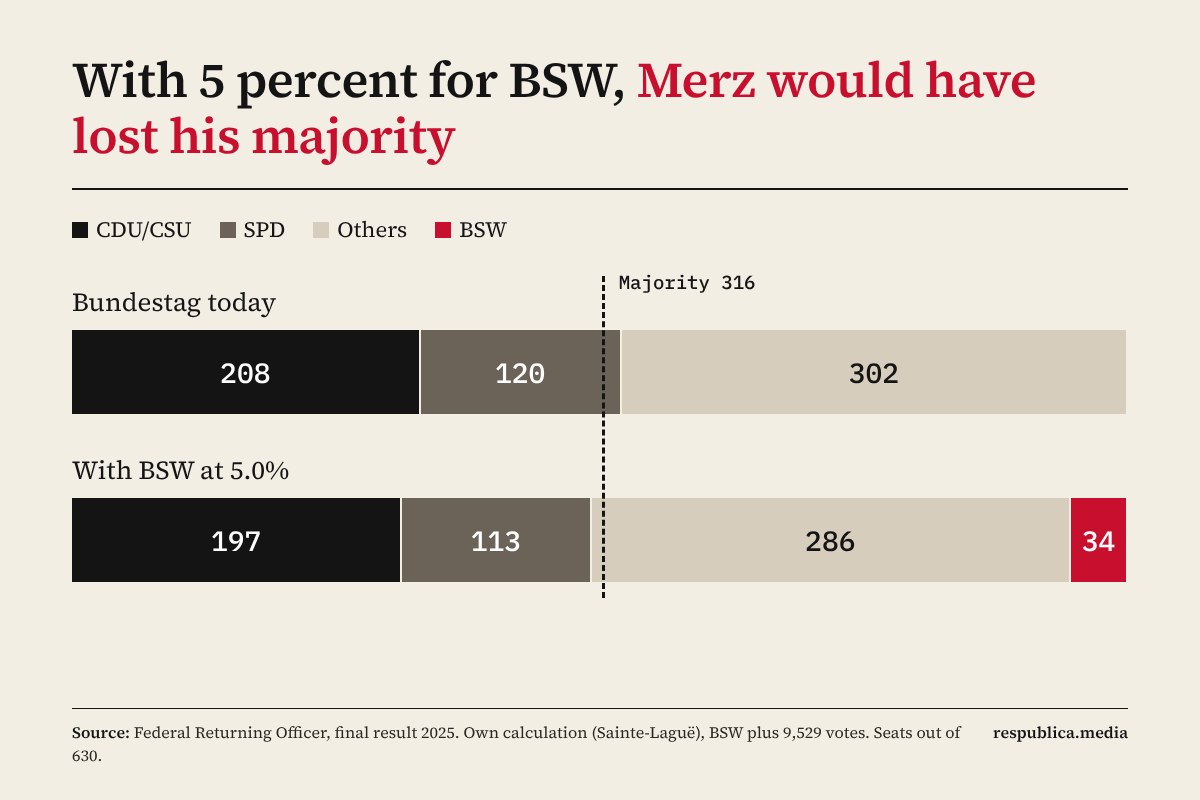
Politically, a lot. At exactly 5 percent, BSW would have won 34 of 630 seats by our own calculation. We redistributed the seats using the statutory Sainte-Laguë method, based on the official result plus 9,529 BSW votes. CDU, CSU and SPD would then hold 310 seats instead of 328. A majority needs 316. Chancellor Friedrich Merz’s coalition would have lost its majority. BSW itself speaks of 35 seats, a difference that depends on where the extra votes are assumed to come from.
That is exactly why the court’s point about Parliament’s ability to function matters. The strict requirements are meant to prevent a properly certified result from being questioned on speculative grounds, leaving an elected Bundestag working under a cloud for years.
Reactions
Wagenknecht called the decision a wrong ruling. Germany now has the election review of a “banana republic”, she said, with the highest court’s blessing. Reviewing close results is now hopeless, she argued, and even real electoral fraud would be possible without the affected party being able to defend itself. De Masi criticised the court to the RND network for deciding without an oral hearing and called it “self-dismantling” of Germany’s highest court.
There is no indication of electoral fraud anywhere in the proceedings. BSW itself did not allege manipulation in Karlsruhe, only counting errors.
Timeline
- 23 February 2025: Federal election, BSW at 2,468,670 votes in the preliminary result.
- March and May 2025: Karlsruhe rejects BSW’s urgent applications, then two further BSW cases, including one on ballot order.
- 14 March 2025: Official result, 4,277 more votes for BSW, still 4.981 percent.
- 22 April 2025: Two objections to the Bundestag, one by four voters, one by BSW itself and others.
- 18 December 2025: The Bundestag rejects the objections as far as the count is concerned, 426 to 129 with one abstention. BSW’s remaining complaints are set aside for later.
- February 2026: Electoral complaint filed in Karlsruhe, 177 pages.
- 20 October 2026: Decision of the Second Senate, published 18 November.
What remains
BSW’s road into this Bundestag is closed. In December 2025 the Bundestag only ruled on the counting complaints and postponed the rest of BSW’s objection. We have not found a decision on those points yet. It is not expected to change the seat distribution.
The bigger question remains open. In July, Karlsruhe already told the Bundestag in another case that it handles election objections too slowly. And the absence of any right to a recount, even at a margin of 0.02 percentage points, is a choice made by lawmakers, not by the court. Wawzyniak proposes making recounts mandatory by law when a result is very close. Many US states, for example, recount automatically when the margin falls below a fixed threshold. Whether the Bundestag wants to take this up is now a political question.
Sources
- Federal Constitutional Court, decision of 20 October 2026, 2 BvC 4/26 (German): https://www.bundesverfassungsgericht.de/SharedDocs/Entscheidungen/DE/2026/10/cs20261020_2bvc000426.html
- Federal Constitutional Court, press release no. 74/2026 (English): https://www.bundesverfassungsgericht.de/SharedDocs/Pressemitteilungen/EN/2026/bvg26-074.html
- German Bundestag, BSW electoral complaint unsuccessful: https://www.bundestag.de/dokumente/textarchiv/2026/kw47-bundesverfassungsgericht-1233738
- German Bundestag, document 21/3100, election review committee recommendation: https://dserver.bundestag.de/btd/21/031/2103100.pdf
- German Bundestag, vote of 18 December 2025: https://www.bundestag.de/dokumente/textarchiv/2025/kw51-de-wahlpruefung-1129218
- Federal Returning Officer, final result 2025: https://bundeswahlleiterin.de/bundestagswahlen/2025/ergebnisse/bund-99.html
- Halina Wawzyniak, Verfassungsblog, 2 December 2025: https://verfassungsblog.de/?p=99356
- LTO, BSW electoral complaint unsuccessful: https://www.lto.de/recht/nachrichten/n/bverfg-2bvc426-bsw-wahlpruefungsbeschwerde-nicht-erfolgreich
- ZDFheute, BSW fails with complaint: https://www.zdfheute.de/politik/deutschland/bsw-klage-bundestagswahl-gescheitert-100.html
- dpa-AFX via onvista, preview with quotes from Wagenknecht and Schönberger: https://www.onvista.de/news/2026/11-18-roundup-bundesverfassungsgericht-entscheidet-zu-bsw-wahlbeschwerde-0-10-26577635
- beck-aktuell, BSW files electoral complaint: https://www.beck-aktuell.de/heute-im-recht/rechtsgeschehen/bsw-wahlpruefungsbeschwerde-bverfg-karlsruhe-2026-02-18
- beck-aktuell, Karlsruhe tells Bundestag to speed up (2 BvC 20/26): https://www.beck-aktuell.de/heute-im-recht/rechtsprechung/bverfg-2bvc2026-wahlrechtspruefung-2025-bundestag-tempo-2026-08-06