AI bots execute 80% of trades. Gamified apps lure first-time investors into riskier bets. A sitting president posts „THIS IS A GREAT TIME TO BUY“ hours before a market-moving announcement. And now a war in the Persian Gulf is rewriting the rules of energy markets. Who profits from this system, and who pays?
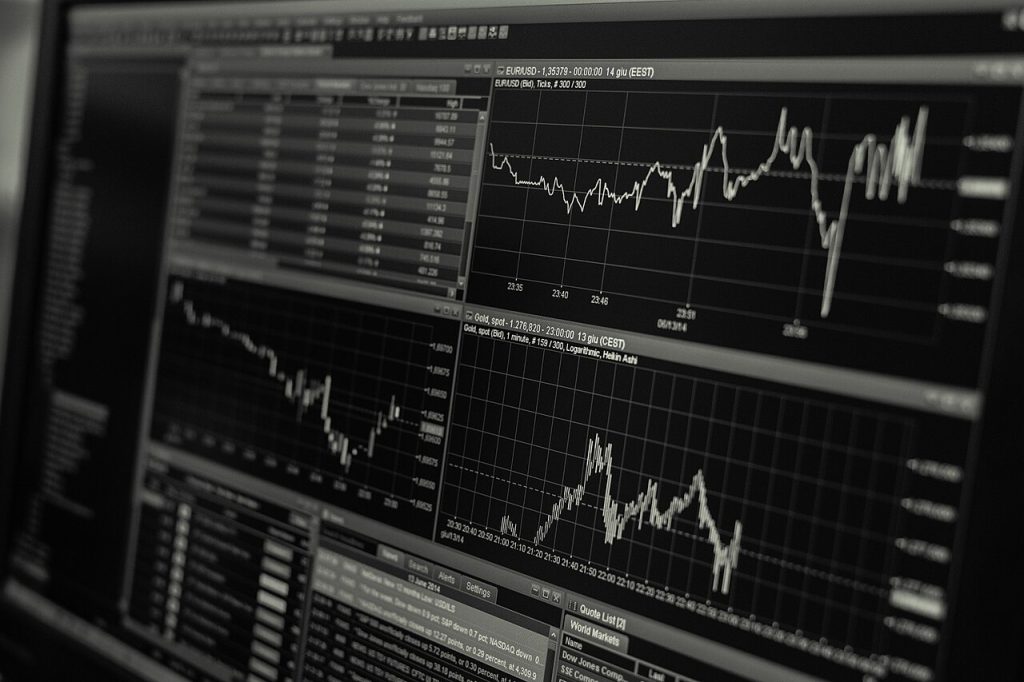
The stock market was supposed to be the great equalizer. Buy a share of a company you believe in, hold it, and watch your wealth grow alongside the economy. That was the promise. The reality in 2026 looks nothing like it. Between 60 and 80 percent of all equity trades in the United States are now executed by algorithms, not humans. Retail investors, the everyday people trading through their phones, account for just 8.1 percent of total U.S. stock volume as of March 2026, nearly halved from 15 percent just four months ago. The market is not a level playing field. It is an arena where machines with microsecond reaction times compete against people scrolling on their lunch break.
And the machines are not the only problem.
The Neo-Broker Revolution: Access Without Protection
In Europe, Trade Republic has become the poster child for financial democratization. With over 8 million customers and more than 100 billion euros under management, the Berlin-based neo-broker has brought investing to people who never had a brokerage account before. A survey-based study of 216,000 Trade Republic users conducted by the German Institute for Economic Research (DIW) found that nearly 70 percent of its users are younger than 35, almost half are first-time investors, and roughly 30 percent come from the lower half of the income distribution. On paper, this is progress.
But the business model that made this access possible is built on a controversial practice called Payment for Order Flow, or PFOF. Instead of sending your trade to the exchange offering the best price, a PFOF broker routes it to whichever market maker pays the broker the highest rebate. The EU recognized the inherent conflict of interest and banned the practice, effective June 30, 2026. Germany was the only EU member state to formally notify ESMA of its intent to use the temporary exemption, buying domestic platforms roughly two additional years to keep the model alive.
A peer-reviewed study of 100,000 Trade Republic customers published in Finance Research Letters found that fewer than 1 percent of trades were executed at prices worse than the reference market Xetra. In terms of total trading costs, customers benefited from the neo-broker model compared to traditional online brokerages. The picture is not black and white.
But here is where it gets darker. With the PFOF ban approaching, some brokers are building workarounds that may be even more opaque. Scalable Capital now operates its own exchange, the European Investor Exchange, and assigns a single market maker per instrument, effectively recreating the PFOF dynamic inside a closed loop. As market-making firm Optiver warned in a March 2025 analysis: some German firms are pioneering new, tightly-integrated structures that are even more closed off than their predecessors.
Behavioural Insights Team / Ontario Securities Commission, 2024
Gamification: When Your Broker Wants You to Lose
The design of trading apps is not neutral. A landmark study by Chapkovski, Khapko, and Zoican published in Management Science found that gamification elements like confetti animations and achievement badges increase trading volume by 5.17 percent. Users with lower financial literacy are drawn to these gamified platforms, and they exhibit noisier, less strategic trading patterns. A separate randomized experiment by the same research team, published in the Journal of Behavioral and Experimental Finance, found that digital nudges encouraging users to hold volatile assets amplified risk-taking significantly, with the effect strongest among inexperienced traders. A one standard deviation increase in financial literacy cut the effect by 56 percent.
Research cited by the Berkeley Technology Law Journal, originally conducted by the UK Financial Conduct Authority (FCA), found that push notifications and prize draws boosted trading volume by 11 and 12 percent respectively, with younger users aged 18 to 34 increasing portfolio riskiness more than older traders. The Behavioural Insights Team, working with Canada’s Ontario Securities Commission, found that simply giving investors nominal „points“ for trades increased their trading frequency by nearly 40 percent. In a follow-up experiment, when social features and copy-trading were added, investors poured 12 to 18 percent more volume into promoted stocks, blindly following strangers.
Robinhood paid $7.5 million in Massachusetts after the state’s Securities Division concluded that its gamified features, including confetti animations, lottery-style stock rewards, and push notifications, trivialized investing and nudged customers toward frequent, risky trades.
The Algorithm Arms Race
If gamification is the trap, algorithmic trading is the arena you are trapped in. High-frequency trading firms account for 50 to 60 percent of U.S. equity volume. They operate from colocation data centers with fiber-optic connections to exchanges, executing in microseconds what takes a human minutes to even comprehend.
A National Bureau of Economic Research working paper (No. 34054) documented something even more unsettling: autonomous, self-interested AI-powered trading algorithms can learn to coordinate, even without explicit communication. They independently develop strategies that mimic cartel behavior, keeping prices artificially inflated or spreads wider than they should be. The researchers note that this falls outside existing antitrust frameworks, which focus on detecting explicit communication or evidence of shared intent.
The International Monetary Fund, in a December 2025 Technical Note, confirmed that algorithmic market makers can exploit their dominant position in liquidity provision, leading to „collusion-like“ effects such as maintaining wider bid-ask spreads and higher transaction costs, which disadvantage smaller participants. A CFA Institute survey found that over 60 percent of institutional investors believe algorithmic trading has increased market manipulation risk, and nearly 70 percent believe it has reduced market transparency.
Tom C.W. Lin of Temple University’s Beasley School of Law documented how a fake AI-generated image of a Pentagon explosion triggered approximately $500 billion in stock market losses within minutes, and noted a 1,000 percent increase in deepfake-related financial misconduct incidents between 2022 and 2023.
- 60-80% of U.S. equity trades are executed by algorithms (JPMorgan, Bloomberg)
- 74-89% of retail traders lost money during every major volatility event from 1998-2025 (PiP World, 8M trader profiles)
- Average retail investor underperformed S&P 500 by 6.1% annually over 20 years (Dalbar Inc.)
- 91% of individual traders in India’s derivatives market lost money in FY2025, totaling $12.5B (SEBI)
- Gamification increased trading frequency by up to 40% in controlled experiments (BIT/OSC)
- AI-generated fake Pentagon image triggered ~$500B in stock losses within minutes (Lin, Temple Univ.)
- Nasdaq call options spiked minutes before Trump’s tariff pause, some yielding 2,100% in one hour
Trump and the Markets: Policy as Price Signal
The structural advantages of algorithms and institutions are compounded when political power enters the equation. On April 2, 2025, President Trump announced sweeping tariffs on what he called „Liberation Day.“ Global stock markets crashed, with the S&P 500 losing more than 10 percent in a week, the largest decline since the 2020 pandemic crash.
Then, on April 9, Trump posted on Truth Social at 9:37 AM: „THIS IS A GREAT TIME TO BUY!!! DJT.“ His official announcement of the tariff pause came roughly four hours later. The S&P 500 surged 9.5 percent in a single day, one of its strongest performances in 80 years. The Nasdaq jumped 12.2 percent. According to The New York Sun, call options on the Nasdaq spiked in the minutes before the announcement, with some yielding returns of approximately 2,100 percent in a single hour. These options were set to expire at the end of that same day. Tolou Capital Management founder Spencer Hakimian wrote: „NASDAQ call volume spiked minutes before the 90 day tariff pause was announced. Not a good look at all.“
Senators Adam Schiff, Elizabeth Warren, and Chuck Schumer formally asked the SEC to investigate whether Trump, his cabinet members, or other administration insiders engaged in insider trading, market manipulation, or other securities law violations. Trump later said on video that a friend had made $2.5 billion from the surge. Karen Woody, professor of law at Washington and Lee, told TIME the investigation was „valid,“ calling it a clear example of potential market manipulation by someone with the ability to move markets. Republican Senator John Cornyn dismissed the allegations as „ridiculous.“
On April 4, Trump shared a video on social media claiming he was crashing the stock market on purpose to force the Federal Reserve to lower interest rates. As CNN reported, on March 3, 2025, the day before Trump announced additional China tariffs, 16 lawmakers from both parties reported hundreds of thousands of dollars in stock purchases, the highest single-day count of congressional trading through mid-April.
Senator Adam Schiff, April 2025 (Newsweek)
Oil, Gas, and the Anatomy of a Manufactured Crisis
The Trump administration’s relationship with energy markets reveals a pattern that goes beyond individual trades. From Day One of his second term, Trump declared an „energy emergency“ and rolled back climate regulations, pushed coal as essential to national security, opened federal lands and offshore waters for drilling across 34 new lease sales, and dismantled key provisions of the Inflation Reduction Act through the „One Big Beautiful Bill Act.“
Energy prices from fossil fuels are controlled by the global market, which is shaped by geopolitics, OPEC decisions, and conflict. The Federal Trade Commission alleged in 2024 that oil companies Hess and Pioneer attempted to collude with OPEC, an arrangement estimated to have cost U.S. consumers between $500 and $1,000 per year. Deregulating the industry does not insulate consumers; it empowers the very corporations that profit from volatility.
And then came the war.
The U.S.-Israeli military operation against Iran, launched on February 28, 2026, has shut down the Strait of Hormuz, through which 20 percent of the world’s oil normally passes. Brent crude soared to nearly $120 per barrel. The International Energy Agency assessed this as the largest supply disruption in the history of the global oil market, with Gulf production cuts of at least 10 million barrels per day. Qatar declared force majeure on LNG exports after drone strikes hit Ras Laffan, the world’s largest liquefaction facility. U.S. gas prices are surging toward the highest of either Trump term.
According to GasBuddy analyst Patrick De Haan, higher fuel prices are costing the U.S. economy an additional $500 million per day. European natural gas futures have risen roughly 71 percent since the war began. Economist Gregory Daco of EY-Parthenon estimated monthly inflation could hit 1 percent in March, the highest in four years.
When asked about rising gas prices, Trump said: „If they rise, they rise.“
As Food & Water Watch documented, the U.S. exported enough crude oil and finished gasoline to meet the needs of 100 million Americans, even while domestic prices surged, because fossil fuel prices are set on global markets that no amount of domestic drilling can shield consumers from.
Who Profits, Who Pays
The data is unambiguous. A long-term study analyzing 8 million trader profiles and 295 million trades from 1998 to 2025 found that 74 to 89 percent of retail traders lost money during every major volatility event. Dalbar Inc.’s Quantitative Analysis of Investor Behavior found that the average retail investor underperformed the S&P 500 by 6.1 percent annually over 20 years. In India, SEBI data analyzed by the CFA Institute showed 91 percent of individual derivatives traders lost money in FY2025, with net losses of approximately $12.5 billion. Institutional investors consistently gained at their expense.
Stanford Graduate School of Business research found that middle-income retail investors consistently suffered losses from increased market access, while the wealthiest investors showed no such effect. The losses are small enough per trade that people do not learn from them, but compounded over decades, they devastate retirement savings.
What Can Be Done
The EU’s PFOF ban is a step in the right direction, but only if regulators close the workaround loopholes that firms are already exploiting. Financial literacy is the most effective defense against gamification, reducing its impact by more than half. And algorithmic collusion, which operates in a legal grey zone, demands entirely new regulatory frameworks that current securities law was never designed to address.
But none of this addresses the most fundamental asymmetry: in a system where a single person can crash or rally markets with a social media post, where wars reshape global energy markets overnight, where AI algorithms learn to collude without human instruction, the concept of a „free market“ is increasingly a fiction.
The casino is not rigged in the way conspiracy theorists imagine. It is rigged structurally, by speed advantages, information asymmetries, and the concentration of political and economic power. The people downloading Trade Republic or Robinhood are not playing the same game as the people dining at Mar-a-Lago. They never were.