
544,000 factory jobs gone: where Germany is losing work
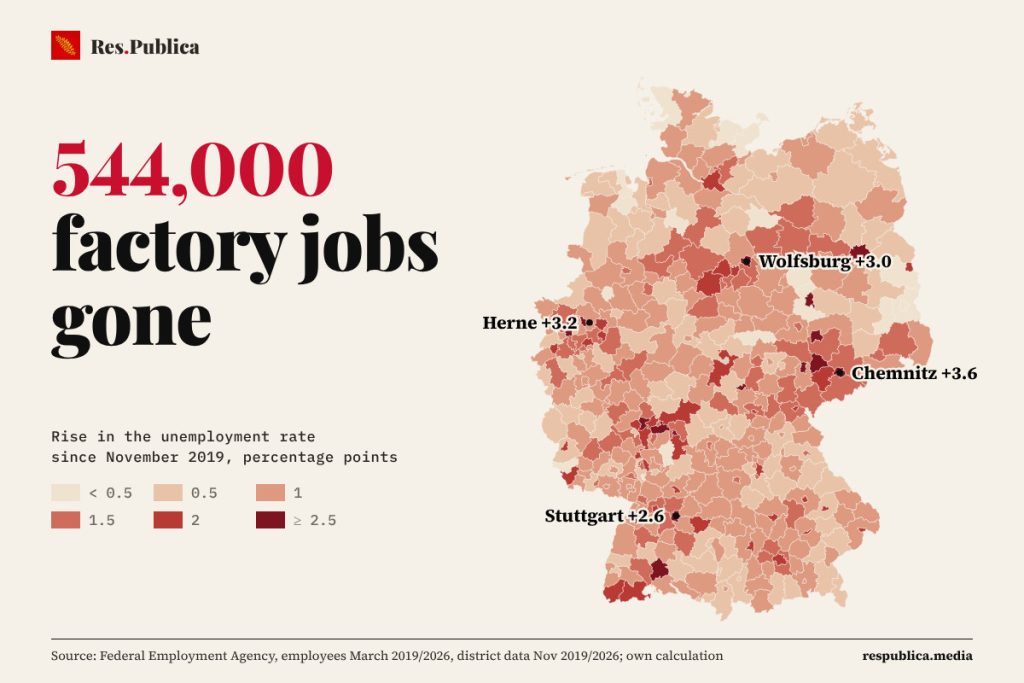
Germany is losing industrial work at a pace that barely shows in the monthly unemployment figures. Since March 2019, manufacturing has shed 544,000 jobs subject to social insurance, 171,000 of them in the past year alone. Over the same period, care, social work, public administration and education added 1.23 million jobs. That is the result of a Res.Publica analysis of Federal Employment Agency (BA) data.
Res.Publica, 27 November 2026.
On Friday the BA published its November figures. Unadjusted, 2.936 million people were registered as unemployed, 19,000 fewer than in October and 51,000 more than a year earlier. Adjusted for seasonal swings, the number rose to 3.025 million. The unemployment rate stands at 6.2 percent. On the same day the Federal Statistical Office reported 224,000 fewer people in work than a year ago.
The monthly headline says little about where work is disappearing and where it is being created. To find out, we compared the BA’s employment statistics by industry for March 2019, March 2025 and March 2026, and the unemployment rates of every German district for November 2019, 2025 and 2026.
Manufacturing is shrinking, and faster
In March 2019, 7.02 million people worked in German manufacturing in jobs subject to social insurance. By March 2026 it was 6.47 million, a drop of 7.8 percent. Almost a third of that decline happened in the past year. The hardest hit are the industries that carry Germany’s export model. Metal production, metal products and machinery together lost 249,000 jobs. Carmakers and their suppliers are down 137,000, or 14 percent. No other single industry cut as many jobs in the past year as the car industry, which lost 50,000.
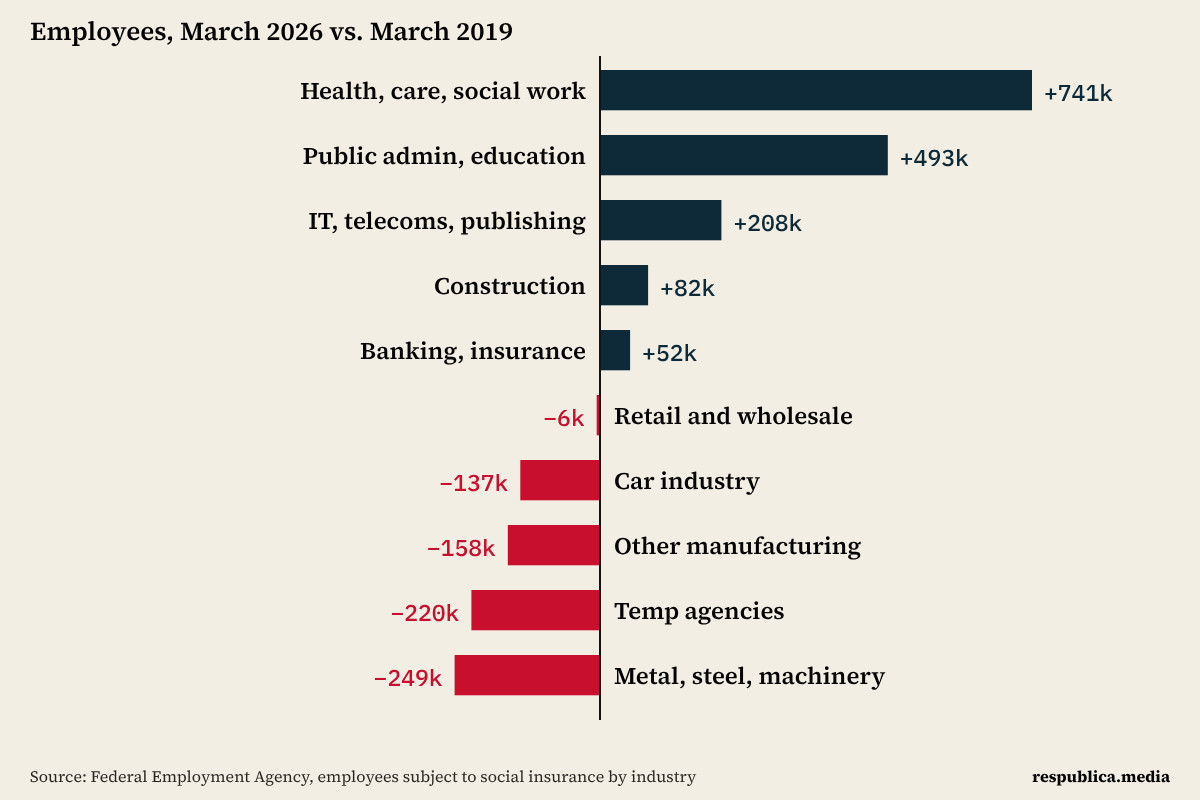
Temporary agency work is an early warning sign. It has shrunk by 220,000 jobs since 2019, almost a third. In a downturn, firms cut agency staff before they touch their core workforce. That temp work fell by another 31,000 jobs in the past year does not suggest a turnaround is near.
Where the new jobs are
Total employment has still grown, from 33.3 to 34.8 million. Health care, care homes and social work together added 741,000 jobs since 2019, 130,000 of them in the past year. Public administration and education added 493,000. That makes 1.23 million new jobs, more than twice as many as manufacturing lost.
IT also grew strongly after 2019, by 208,000 jobs. In the past year, however, it shrank for the first time, by 18,000 jobs or 1.5 percent. The sharpest fall was in telecommunications, down 8 percent. Retail and wholesale are roughly where they were in 2019.
The jobs being lost generated taxes and contributions. The jobs being added are largely paid for out of taxes and contributions.
This shift is more than a statistical curiosity. Care, childcare, schools and public administration are essential, and an ageing society needs more of them. But they are mostly financed through social contributions and taxes. Manufacturing, by contrast, generates a large share of the exports and value added from which that revenue flows. How long an economy can sustain growing publicly funded employment on a shrinking industrial base is one of the central economic questions of the coming years. The data do not answer it, but they make it more urgent.
The south is catching up
The regional pattern is surprising. Unemployment has risen fastest where it was lowest for years. In Bavaria and Baden-Württemberg the rate is now almost half as high again as in November 2019: 4.0 instead of 2.7 percent in Bavaria, 4.6 instead of 3.1 percent in Baden-Württemberg. Nationally the increase is just under a third, from 4.8 to 6.2 percent. It was smallest in Bremen, Mecklenburg-Western Pomerania and Brandenburg. The south still has the lowest rates in the country.
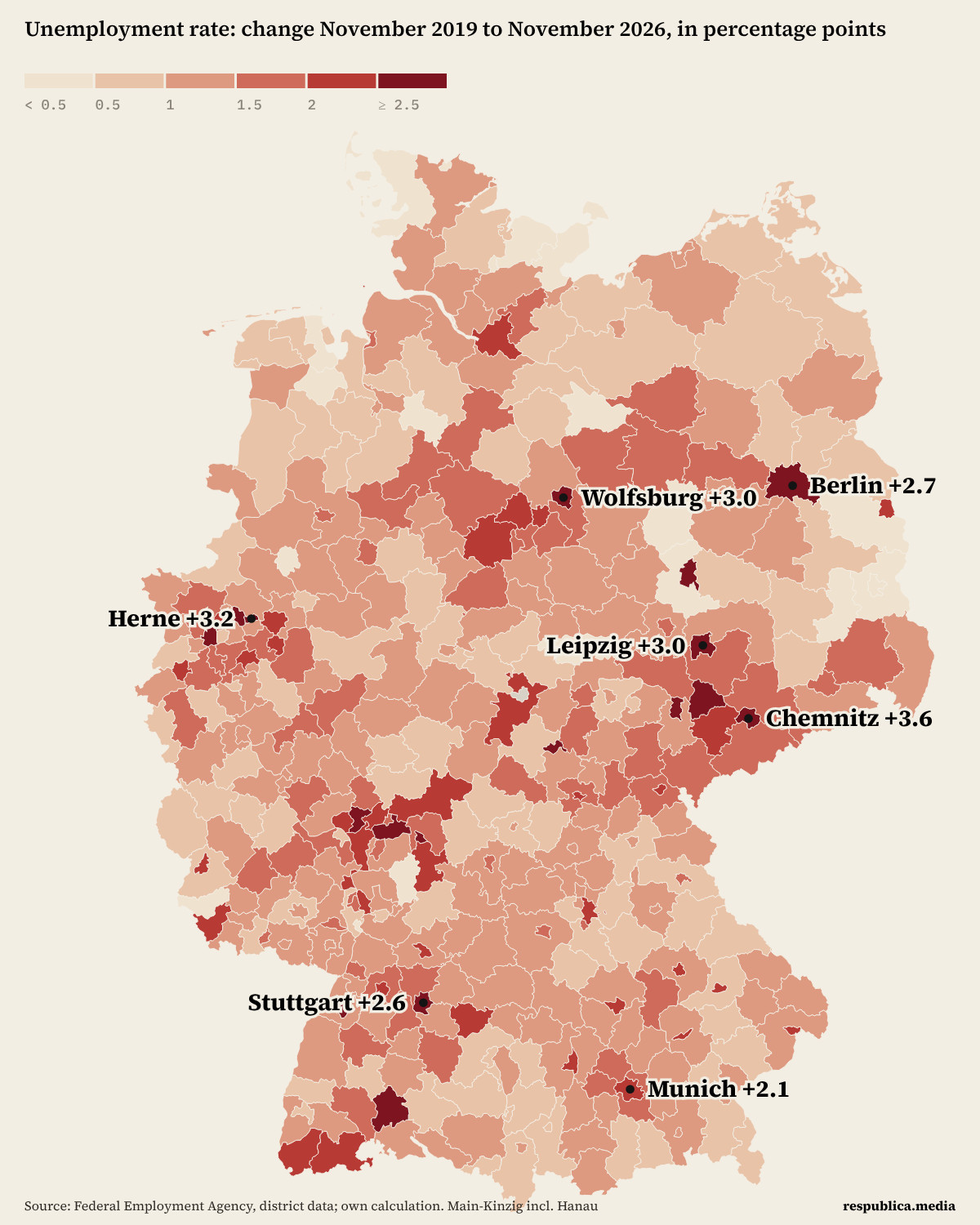
At district level, industrial towns stand out. In Wolfsburg, home of Volkswagen, the rate climbed from 4.1 to 7.1 percent. In Stuttgart it rose from 4.2 to 6.8, in Ingolstadt, where Audi is based, from 2.8 to 4.9, and in Zwickau from 4.0 to 6.3 percent. The largest increase of all 401 districts was in Chemnitz, up 3.6 points to 9.9 percent, followed by Herne, up 3.2 points to 12.7 percent. Unemployment remains highest in the Ruhr and in Bremerhaven: Gelsenkirchen is at 15.3 percent, Bremerhaven at 13.7, Duisburg at 13.2.
Over the past year unemployment rose in 265 of the 401 districts, most clearly in Herne, Erfurt and the district of Offenbach, by 0.8 to 0.9 points each. In Schwerin, Cottbus and Pirmasens it fell noticeably.
- According to Bloomberg, SAP is weighing at least 10,000 job cuts worldwide as it restructures around artificial intelligence. SAP says no decision has been made.
- Insurers Ergo and Allianz Partners have explicitly cited AI for job cuts, and Commerzbank CEO Bettina Orlopp has called AI a very large part of the bank’s planned reductions. The services union Verdi is negotiating a dedicated AI collective agreement with insurers.
- So far, though, the big losses come from factories, not offices. In October the Institute for Employment Research (IAB) found no AI-driven slump: in occupations highly exposed to AI, full-time employment in 2025 was about 1 percent above 2022, in low-exposure occupations about 3 percent below.
- Only among 20- to 29-year-olds was there a slight dip, and it is not statistically significant. According to the IAB, the business cycle matters far more. Whether the first decline in IT employment is a harbinger cannot yet be read from the data.
Reasons not to panic
Three things put the picture in perspective. First, there are 1.54 million more employees subject to social insurance today than in 2019. Germany does not have less work overall, it has different work. Second, unemployment is far from earlier crises. In 2005 more than 5 million people were registered as unemployed. Third, 646,000 vacancies are registered, 23,000 more than a year ago. Many of them are in care, education and skilled trades, fields a laid-off factory worker cannot simply move into.
That is exactly the problem. Unemployment and labour shortages exist side by side because jobs are being created in different places and occupations than those where they are lost. A machine builder from Heidenheim does not become a nursery teacher in Munich without retraining. The transition takes time, and during that time unemployment rises even if total employment holds steady.
How we calculated
We used the Federal Employment Agency’s tables on employees subject to social insurance by industry (WZ 2008 classification) on 31 March 2019, 2025 and 2026, and unemployment rates by district for November 2019, 2025 and 2026. Manufacturing means divisions 10 to 33. Care and social work covers divisions 86 to 88, public administration and education 84 and 85, IT 58, 61, 62 and 63.
The BA revised its employment statistics in 2023. The 2019 figures come from the publication at the time, so comparisons with 2019 should be read as orders of magnitude. Comparisons between 2025 and 2026 are not affected. Employees are counted at their place of work, unemployed people at their place of residence. Hanau has been a separate district since 2026; for the comparison with 2019 we merged it with Main-Kinzig. Raw data available on request. How unemployment in Germany compares with other countries is shown on the world map in the Res.Publica Dashboard.
Sources
- Federal Employment Agency, press release no. 47, labour market in November 2026: https://www.presseportal.de/pm/6776/6399040
- Federal Employment Agency, unemployed and unemployment rates, Germany, states and districts, November 2026 and December 2019: https://statistik.arbeitsagentur.de/SiteGlobals/Forms/Suche/Einzelheftsuche_Formular.html?topic_f=gemeinde-arbeitslose-quoten
- Federal Employment Agency, employees by industry (WZ 2008), quarterly, March 2019, 2025 and 2026: https://statistik.arbeitsagentur.de/SiteGlobals/Forms/Suche/Einzelheftsuche_Formular.html?topic_f=beschaeftigung-sozbe-wz-heft
- Federal Statistical Office, employment in October 2026: https://www.destatis.de/DE/Presse/Pressemitteilungen/2026/11/PD26_412_132.html
- Reuters, seasonally adjusted unemployment November 2026: https://www.investing.com/news/economy-news/german-unemployment-rises-more-than-expected-in-november-5053161
- IAB, press release of 13 October 2026: https://iab.de/presseinfo/ki-bisher-kein-jobkiller-aber-berufseinsteiger-zunehmend-betroffen/
- IAB-Forum, AI as a job killer for young workers?: https://iab-forum.de/ki-als-jobkiller-fuer-berufseinsteiger-entwarnung-mit-vorbehalt/
- Bloomberg, SAP Weighs Cutting at Least 10,000 Roles in AI Restructure, 26 Nov 2026: https://www.bloomberg.com/news/articles/2026-11-26/sap-weighs-cutting-at-least-10-000-positions-in-ai-restructuring
- Euronews, SAP statement, 27 Nov 2026: https://www.euronews.com/2026/11/27/german-sofware-giant-sap-weighs-at-least-10000-job-cuts-amid-ai-shift-reports-say
- Handelsblatt, insurers negotiate with union on AI, 24 March 2026: https://www.handelsblatt.com/finanzen/banken-versicherungen/versicherer/stellenabbau-deutsche-versicherer-verhandeln-mit-gewerkschaft-zu-ki/100211146.html
- Versicherungswirtschaft heute, Allianz Partners and AI, 31 March 2026: https://versicherungswirtschaft-heute.de/schlaglicht/2026-03-31/die-allianz-wird-nicht-das-einzige-unternehmen-bleiben-dass-ki-nutzt-um-personal-zu-reduzieren/
- gabble.it, how AI is changing German banks in 2026 (Orlopp quote via dpa), 19 Nov 2026: https://www.gabble.it/2026/11/ki-jobwandel-deutsche-banken-2026/
Read next
 Germany Needed: 9,529 votes, proven: 146. Why Germany’s top court won’t order a recount
18.11.2026
 Europe Germany wants to deport to Rwanda, a country its own government accuses of breaking international law
17.11.2026
 Germany 14 and 15 years old, accused of right-wing terror: what we know about “Terror 18”
26.11.2026

Luca Calcagno is a journalist and the founder and editor of Res.Publica. He studies political science (B.A.) with a focus on politics, law and sociology, and analyses public data on the Bundestag, the German lobby register, elections and democracy. His work covers German, European and international politics.