
Violence against women 2025: 47,000 killed by partner or family

47,000 women and girls were killed by an intimate partner or family member in 2025, according to new United Nations estimates. That is 129 a day. In Germany, 209 women and girls died as a result of domestic violence, 130 of them killed by a partner or ex-partner, new police data show. In Berlin, the governing parties are arguing over how such killings should be punished as murder.
Res.Publica, 25 November 2026, International Day for the Elimination of Violence against Women.
Worldwide: home remains the most dangerous place
The UN Office on Drugs and Crime (UNODC) and UN Women estimate that 78,000 women and girls were intentionally killed in 2025. 47,000 of them, 60 percent, were killed by an intimate partner or family member. That is five every hour.
The rate is highest in Africa, with 2.9 victims per 100,000 women and girls. The Americas follow with 1.4, Oceania with 1.1, Asia with 0.6 and Europe with 0.5.
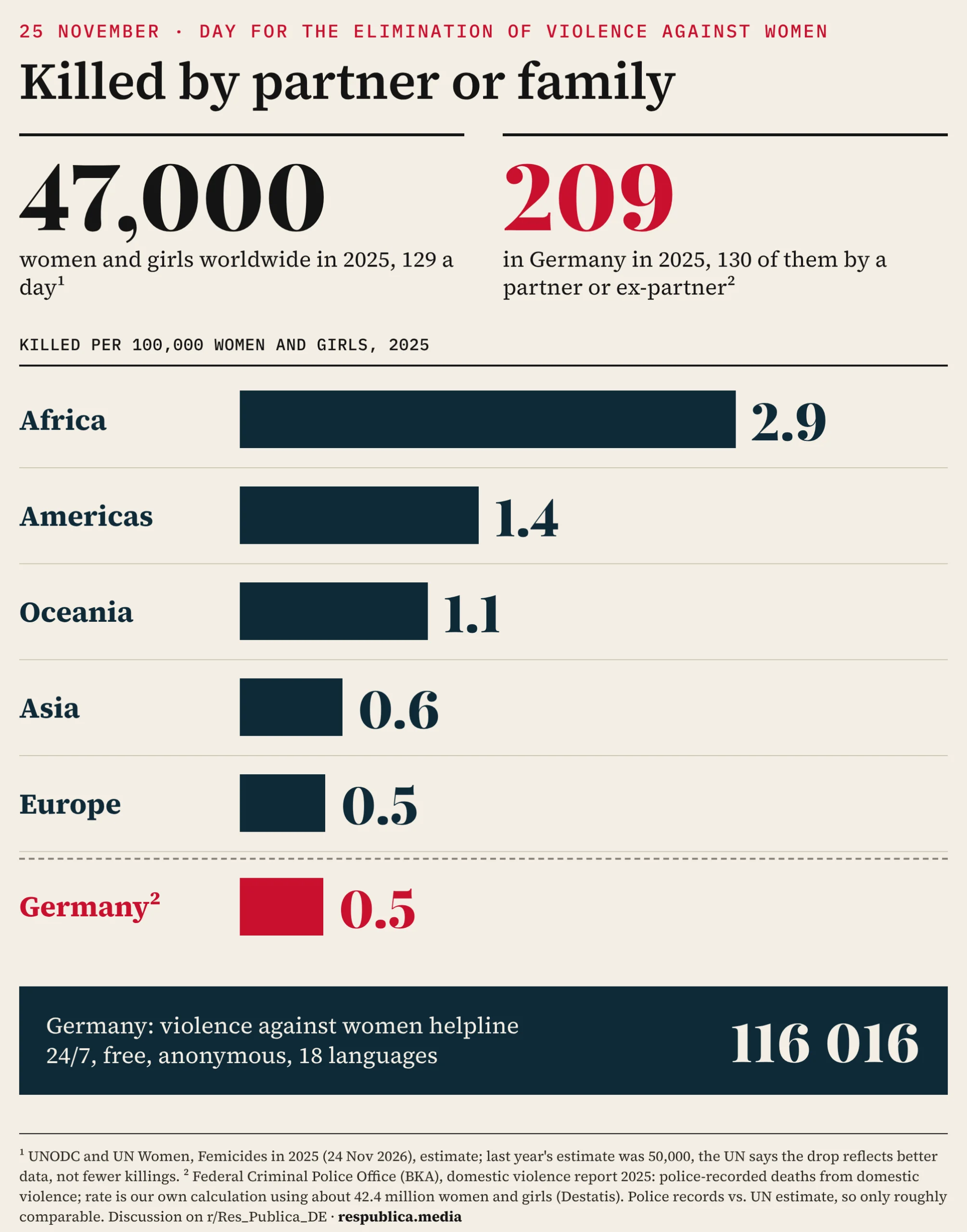
The figure of 47,000 is lower than the 2024 estimate of 50,000. The UN says this is not an actual decrease but largely the result of better data at country level. Over the long run, killings overall are falling faster than femicides: between 2010 and 2025, homicide rates declined nearly twice as fast as femicide rates in the Americas and about 1.5 times as fast in Europe.
Germany: a record in domestic violence
Germany’s Federal Criminal Police Office (BKA) published its reports for 2025 on 24 November. Police recorded 280,129 victims of domestic violence, up 2.8 percent and the highest number on record. 70.6 percent of victims were female, close to 198,000 women and girls.
More than 142,800 women and girls were victims of intimate partner violence, which works out to more than 16 every hour. About three quarters of suspects in domestic violence cases are men.
292 people died as a result of domestic violence, among them 209 women and girls. 130 of them were killed by a partner or ex-partner. With about 42.4 million women and girls in the country, that puts Germany at roughly 0.5 per 100,000, right at the European average. The comparison is rough: the German number comes from police records, the UN figures are estimates.
According to the BKA, offences against women rose in every category it tracks, even though violent crime overall is falling. 54,675 women and girls were victims of a sexual offence, almost half of them minors. Female victims of digital violence, such as online threats and stalking, rose by almost 16 percent to 31,221.
What the statistics miss
All German figures come from police crime statistics and only show what is reported. LeSuBiA, Germany’s first large survey on unreported violence, found reporting rates below ten percent for most forms of violence. Only three percent of women who experience sexual assault go to the police.
A rise in the statistics can also mean more victims are going to the police. It certainly does not show that violence is falling.
Police statistics do not record motives either. Nobody can say how many of the 130 women were killed because they were women. The BKA has now published a definition of femicide for the first time, but it does not yet count by it.
The German debate: motive or act
German law distinguishes murder, which carries a life sentence, from manslaughter. A killing counts as murder only if it meets one of a list of criteria, such as “base motives”. Justice Minister Stefanie Hubig, a Social Democrat, wants to add “gender-specific” and “other contemptuous” motives to that list. According to the legal news site LTO, the aim is not to widen criminal liability but to make clear that killings driven by possessiveness count as murder. Courts have at times shown understanding for men who killed a partner after a separation and convicted them only of manslaughter.
The conservative CDU/CSU, Hubig’s coalition partner, also wants a new murder criterion, but one that “starts with the act itself”, according to a position paper quoted by the news agency dpa. Killings of women by partners or ex-partners should then consistently be punished as murder. The exact wording has not been made public.
The difference matters in practice. A motive has to be proven in court, and that is where murder convictions often fail today. A criterion based on the act would be easier to prove, but could also cover cases with no possessive motive behind them. Both sides agree on the goal. The route is still being negotiated.
- Violence against women helpline: 116 016, 24 hours a day, free, anonymous, in 18 languages
- Online counselling by chat and e-mail: hilfetelefon.de
- In immediate danger: police 110
How members of the Bundestag vote on protection laws can be tracked in the Res.Publica Dashboard.
Sources
- UN Women and UNODC, press release “Five women killed every hour by a partner or close relative in 2025”, 24 November 2026: https://www.unwomen.org/en/news-stories/press-release/2026/11/five-women-killed-every-hour-by-a-partner-or-close-relative-in-2025
- UNODC and UN Women, Femicides in 2025: https://www.unwomen.org/en/digital-library/publications/2026/11/femicides-in-2025-global-estimates-of-intimate-partner-family-member-femicides
- BKA, press release (German), 24 November 2026: https://www.bka.de/DE/Presse/Listenseite_Pressemitteilungen/2026/Presse2026/261124_PM_BLB_HG_GgF.html
- BKA, Domestic Violence Report 2025 (German): https://www.bka.de/SharedDocs/Downloads/DE/Publikationen/JahresberichteUndLagebilder/HaeuslicheGewalt/HaeuslicheGewalt2025.pdf?__blob=publicationFile&v=3
- BKA, Report on gender-specific offences against women 2025 (German): https://www.bka.de/SharedDocs/Downloads/DE/Publikationen/JahresberichteUndLagebilder/StraftatenGegenFrauen/StraftatengegenFrauenBLB2025.pdf?__blob=publicationFile&v=2
- BKA, LeSuBiA survey (German): https://www.bka.de/DE/UnsereAufgaben/Forschung/ForschungsprojekteUndErgebnisse/Dunkelfeldforschung/LeSuBiA/lesubia_node.html
- dpa via Stuttgarter Nachrichten (German), 23 November 2026: https://www.stuttgarter-nachrichten.de/politik/gewalt-gegen-frauen-union-will-femizide-haerter-bestrafen-79774343.html
- LTO, press review on the murder law reform (German), 23 November 2026: https://www.lto.de/recht/presseschau/p/2026-11-23-femizid-mordparagraf-igh-genozid-linkenschau-satire
- Hilfetelefon Gewalt gegen Frauen: https://www.hilfetelefon.de/
Read next


Luca Calcagno is a journalist and the founder and editor of Res.Publica. He studies political science (B.A.) with a focus on politics, law and sociology, and analyses public data on the Bundestag, the German lobby register, elections and democracy. His work covers German, European and international politics.