
1,682 wolves in Germany: growth is slowing
Foto: Gary Kramer, U.S. Fish and Wildlife Service, gemeinfrei
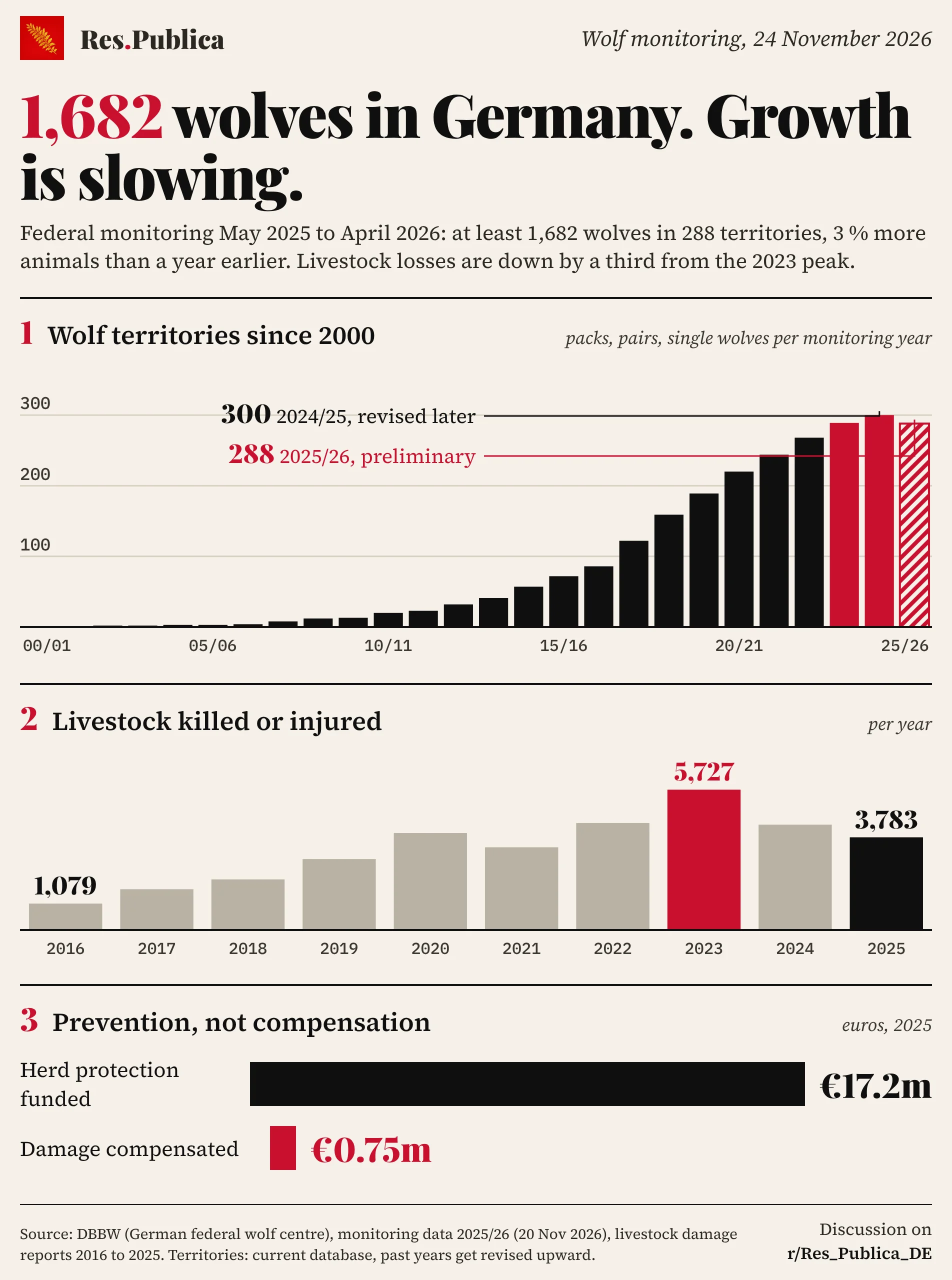
At least 1,682 wolves live in Germany, spread across 288 territories. That is the result of the federal monitoring for May 2025 to April 2026, published on 20 November by the DBBW, the federal government’s documentation and advisory centre on wolves. It is 3 percent more animals than a year earlier. At the same time, wolves are killing far fewer sheep and cattle than in the record year 2023.
Res.Publica, 24 November 2026.
The DBBW titled its release “only small increases for the second year in a row”. Confirmed territories rose from 276 to 288, an increase of 12: 238 packs, 38 pairs and 12 single wolves holding a territory. The number of animals went from 1,636 to 1,682. Almost half of them are pups: 818. Between 530 and 627 are adults; for 97 animals it was not clear whether they were fully grown.
Where the wolves live
Five states account for 246 of the 288 territories: Brandenburg (64), Lower Saxony (62), Saxony (48), Saxony-Anhalt (40) and Mecklenburg-Western Pomerania (32). The core range stretches from Lower Saxony in the northwest to Saxony in the east. Bavaria has 14 territories, Thuringia 7, Baden-Württemberg and North Rhine-Westphalia 5 each, Hesse and Rhineland-Palatinate 4 each, Schleswig-Holstein 3. Saarland is the only territorial state without a single wolf territory. The area where wolves occur grew by about 7 percent, mostly because gaps inside the known range are closing.
- Brandenburg: 64
- Lower Saxony: 62
- Saxony: 48
- Saxony-Anhalt: 40
- Mecklenburg-Western Pomerania: 32
- Bavaria: 14
- Thuringia: 7
- Baden-Württemberg, North Rhine-Westphalia: 5 each
- Hesse, Rhineland-Palatinate: 4 each
- Schleswig-Holstein: 3
Why the curve is not falling, even if it looks like it
The DBBW database now shows 300 territories for 2024/25 and only 288 for 2025/26. That is not a decline. Each year’s figures are revised later, for example when a pack with pups turns up the following year, which proves a pair was already there. That added 24 territories to 2024/25, almost all of them pairs. The DBBW expects 2025/26 to rise a little as well. The fair comparison is therefore the first published figure: 276 against 288.
Still, growth is clearly slowing. Between 2017/18 and 2018/19, by today’s data, 37 territories were added in a single year, an increase of 30 percent. Now it is 4 percent. The conservation group Nabu told the German news agency dpa that natural limits have probably already been reached in some regions. That is one organisation’s reading. The monitoring itself does not measure limits; it counts confirmed animals.
Fewer livestock killed
Damage figures come from a second DBBW report that compiles the states’ data per calendar year. In 2025 there were 990 confirmed wolf attacks on livestock, with 3,783 animals killed, injured or missing. In the record year 2023 it was 1,268 attacks and 5,727 animals. That is a third fewer, even though there are more wolves today.
87 percent of the animals harmed were sheep or goats, 8 percent farmed deer, 4 percent cattle, mostly calves. Most damage was recorded in Lower Saxony (970 animals), Brandenburg (770) and Saxony (546). It is very unevenly spread: in Saxony in 2023, according to the DBBW, 78 percent of the damage happened in 17 percent of the territories.
Fencing is what matters. In the states that publish this data, between just under half and well over three quarters of attacks on sheep and goats hit flocks with no or only limited minimum protection: 69 percent in Brandenburg, 73 percent in Lower Saxony, 46 percent in Saxony.
For every euro paid in compensation, German states spent about 23 euros on herd protection in 2025.
The money goes into fences
In 2025 the states funded herd protection with 17.2 million euros, for electric fences, livestock guardian dogs and running costs. Compensation for damage came to 747,000 euros. In 2024 funding had peaked at 23.4 million euros. The parts of the report we read do not explain the drop.
What changed on culling
Since 2 April 2026 the wolf has been covered by Germany’s federal hunting law. The Bundestag passed the change on 5 March with votes from the conservative CDU/CSU, the far-right AfD and the Social Democrats; the Greens and the Left voted against. It became possible after the wolf’s protection status was lowered from “strictly protected” to “protected” under the Bern Convention and the EU Habitats Directive. States can now introduce regional population management including hunting where the population is in good condition. Wolves that have overcome herd protection and killed livestock may be removed. Special rules apply to alpine pastures and dykes, where fencing is hardly possible.
Little of this shows up in the monitoring yet. The monitoring year ended on 30 April, so the new law applied for only four weeks of it. In 2025/26 two wolves were removed because of livestock attacks. Traffic remains the main cause of death: of 172 wolves found dead, 118 were killed on roads. Nine were proven to have been killed illegally.
The monitoring cannot say how many wolves Germany can live with. It does show that the population is growing more slowly and that damage happens mostly where flocks are poorly protected.
Sources
- DBBW, press release “Ergebnisse des Wolfsmonitorings 2025/26 veröffentlicht”, 20 Nov 2026: https://www.dbb-wolf.de/files/media/Wolfsvorkommen/amtliche%20Monitoringzahlen/AmtlicheMonitoringergebnisse_2026.pdf
- DBBW, territories by state 2025/26: https://www.dbb-wolf.de/Wolfsvorkommen/territorien/status-und-reproduktion
- DBBW, territories since 2000: https://www.dbb-wolf.de/Wolfsvorkommen/territorien/entwicklung-diagramm
- DBBW, dead wolves by cause: https://www.dbb-wolf.de/Totfunde/entwicklung-der-totfunde-diagramm
- DBBW, reports on prevention and livestock damage 2016 to 2025: https://www.dbb-wolf.de/service/literatur-download/praevention
- German Bundestag, vote on hunting wolves, 5 Mar 2026: https://www.bundestag.de/dokumente/textarchiv/2026/kw10-de-bundesjagdgesetz-1150486
- German Hunting Association (DJV), amended hunting law in force: https://www.jagdverband.de/geaendertes-bundesjagdgesetz-tritt-kraft
- dpa via t-online, 23 Nov 2026: https://www.t-online.de/nachrichten/panorama/wissen/id_101542252/kaum-zuwachs-bei-den-woelfen-in-deutschland.html
- Featured photo: Gary Kramer, U.S. Fish and Wildlife Service, public domain: https://commons.wikimedia.org/wiki/File:Front_view_of_a_resting_Canis_lupus_ssp.jpg
Read next




Luca Calcagno is a journalist and the founder and editor of Res.Publica. He studies political science (B.A.) with a focus on politics, law and sociology, and analyses public data on the Bundestag, the German lobby register, elections and democracy. His work covers German, European and international politics.