
Most Germans now oppose Ukraine military aid, yet still fear Russia
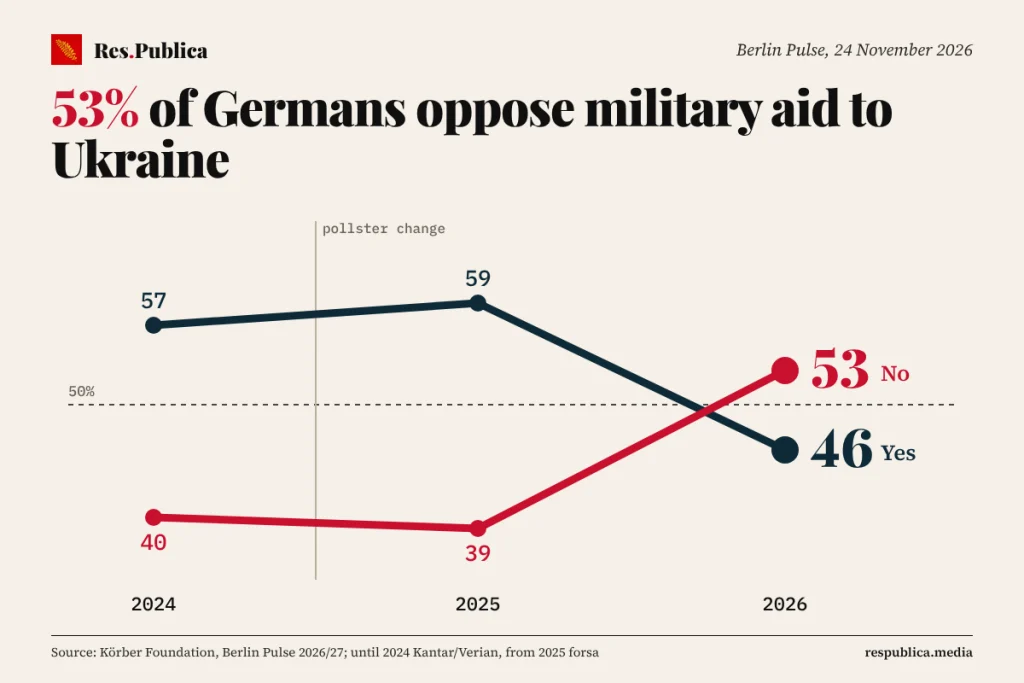
A majority of Germans now oppose further military aid to Ukraine. In the Körber Foundation’s new Berlin Pulse survey, 53 percent say no and 46 percent say yes. A year ago it was almost the reverse: 59 percent in favour, 39 percent against. Support fell among supporters of every party. That does not mean Germans have grown softer on Russia: 82 percent see it as a military threat.
Res.Publica, 24 November 2026.
The Berlin Pulse is an annual survey on German foreign policy by the Hamburg-based Körber Foundation, now in its tenth edition. The pollster forsa interviewed 1,501 eligible voters by telephone between 15 and 28 September. The question reads: Should Germany provide military assistance to Ukraine in the war with Russia?
Down in every party
The sharpest drop came among Green supporters, from 90 to 73 percent. Among CDU/CSU supporters, support fell from 80 to 67 percent, among SPD supporters from 75 to 64. Left Party supporters went from 66 to 61 percent, AfD supporters from 18 to 11. That means 88 percent of AfD supporters now reject any military aid.
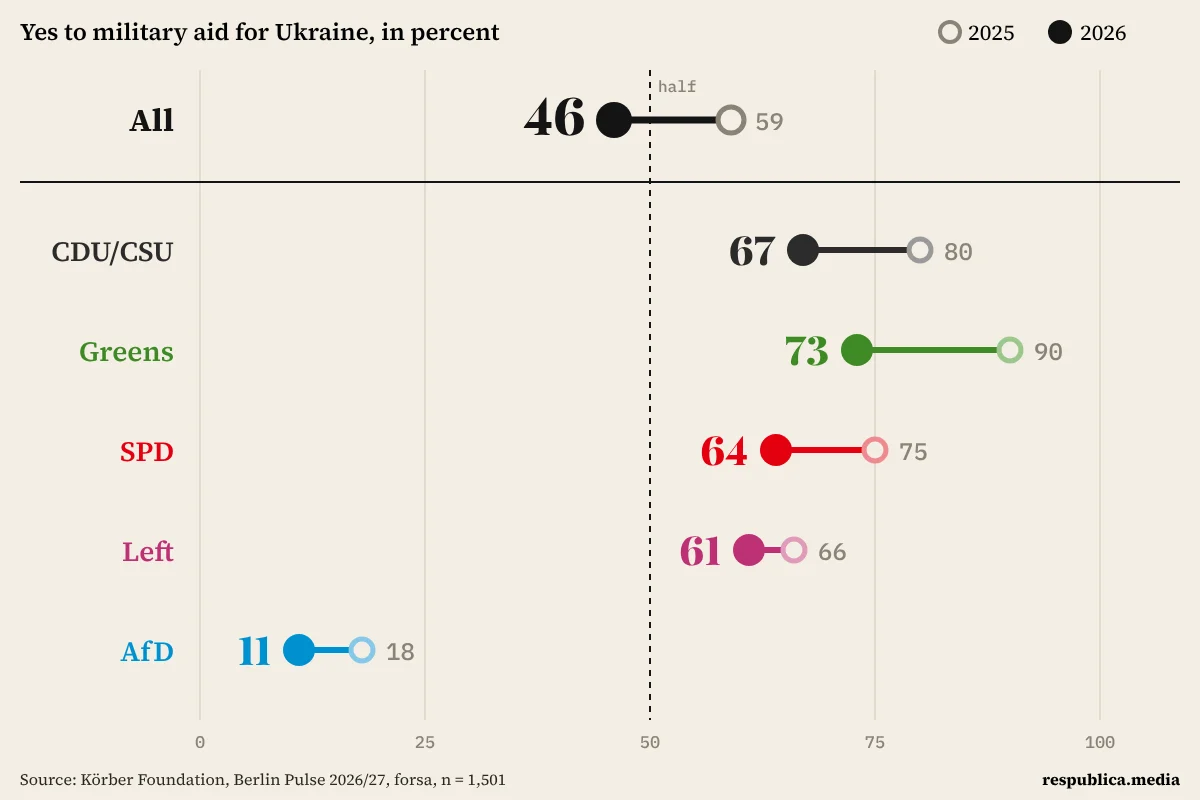
The party figures need care. Only about 150 to 330 people were interviewed per party, so the margin of error is several points. The 5-point drop among Left supporters may be noise. The drops among Greens, CDU/CSU and SPD are too large for that. The report gives no 2026 figures for the FDP and BSW.
The comparison with 2025 is clean: both years were run by forsa with the same question. Until 2024 the survey was carried out by Kantar Public, later Verian. In 2024, 57 percent said yes and 40 percent no. The Körber Foundation itself notes that these older figures are only partly comparable: age brackets and education categories differ, and forsa’s weighting is not documented.
Threat yes, aid no
What has not changed is just as striking. 82 percent see Russia as a military threat. That figure combines two answers: 45 percent see a major threat, 37 percent a minor one. Only 17 percent see none. 64 percent reject normalising relations with Moscow, for example by easing sanctions or importing more energy.
A large majority considers Russia dangerous. Yet a narrow majority no longer wants to help Ukraine militarily.
On whether Ukraine is also defending the security of Germany and Europe, the country is split: 50 percent yes, 48 percent no. And 61 percent say Germany and Europe are not doing enough for peace negotiations. The mood in short: Russia remains a danger, but fewer people than a year ago are convinced that weapons for Ukraine are the answer.
Part of a wider shift
The Ukraine question does not stand alone. 48 percent want Germany to hold back in international crises, up from 43 percent in 2025. Only 40 percent, down from 48, want more engagement. The Körber Foundation calls this a turning point. Among AfD supporters, 84 percent favour restraint.
The forsa data tables show how closely the two are linked. Among those who oppose military aid to Ukraine, 68 percent want Germany to hold back in general. Among supporters it is 26 percent. And of those who see Russia as a major threat, only 34 percent favour restraint, compared with 75 percent of those who see no threat. Attitudes on Ukraine are less a standalone decision than part of a broader question: should Germany get involved in the world or stay out?
- 46% back military aid to Ukraine (2025: 59%), 53% oppose it (2025: 39%)
- 82% see Russia as a military threat, 45% as a major one
- 61% say too little is being done for peace talks
- 48% favour foreign policy restraint (2025: 43%)
- 21% rate relations with the United States as good
- 69% want a nuclear umbrella from France and the UK, 13% want German nuclear weapons
What the survey does not show
The question does not distinguish between weapons, money and training, and it does not ask about scale. Someone who says no may oppose all aid or only more aid than today. It also does not measure reasons. Whether cost, fear of escalation or doubts about a Ukrainian victory tip the balance remains open.
It is also a snapshot. Fieldwork ran in September, before Russia’s large-scale attack of 20 November. How such events shift opinion will only show in the next wave.
One group is missing in 2026: BSW supporters, only 30 percent of whom backed military aid in 2025, are no longer shown separately. On the party’s situation after the federal election, see our piece on its election complaint at the Constitutional Court. How members of the Bundestag vote is tracked in the Res.Publica dashboard.
Sources
- Körber Foundation, The Berlin Pulse 2026/27, Security & Defence chapter: https://www.theberlinpulse.org/reports/berlin-pulse-2026-27/security-defence
- Körber Foundation, The Berlin Pulse 2026/27, Germany and the World chapter: https://www.theberlinpulse.org/reports/berlin-pulse-2026-27/germany-and-the-world
- Körber Foundation, project page The Berlin Pulse 2026/2027: https://koerber-stiftung.de/en/projects/the-berlin-pulse/2026-27/
- forsa, Meinungen zur Außenpolitik 2026, data tables (German), 2 October 2026: https://koerber-stiftung.de/site/assets/files/58252/forsa_tabellenband_the_berlin_pulse_2026.pdf
- t-online, Ukraine-Hilfe: Rückhalt der Deutschen sinkt laut neuer Umfrage deutlich, 24 November 2026: https://www.t-online.de/nachrichten/deutschland/aussenpolitik/id_101544006/ukraine-hilfe-rueckhalt-der-deutschen-sinkt-laut-neuer-umfrage-deutlich.html
Read next


Luca Calcagno is a journalist and the founder and editor of Res.Publica. He studies political science (B.A.) with a focus on politics, law and sociology, and analyses public data on the Bundestag, the German lobby register, elections and democracy. His work covers German, European and international politics.